Basic HTML Version



DON’T SLIP UP
colour and texture. It is also easy to handle and process as
well as having excellent physical properties. It is a multi-
component polyurethane foam system that is compatible
with all dosing machines currently on the market and has
been specifically designed for the production of high-quality
midsoles and non-slip outsoles for a variety of end uses
where these other features also apply.
1. Shaped moulded soles for dress and leisure shoes where
it offers comfort, lightweight for ergonomic efficiency,
good durability and flexibility in regard to sole design
and colour.
2. Direct soling on trekking boots where its lightweight
provides an advantage in terms of the wearer’s
performance. It is also sturdy, abrasion-resistant and
shock absorbing to ease strain on joints and muscles.
3. Moulded sole units where it offers resistance to oil and
petroleum products for industrial and safety footwear as
well as being anti-static.
4. Moulded insoles, orthopaedic walking aids, bath mules
and clogs where its lightweight makes it easy on the foot.
It is also resistant to abrasion and hydrolysis, and can be
combined to other materials such as leather, cork, wood,
textiles or felt.
ELASTOPAN PLUS ELASTOLLAN
Elastollan is highly resistant to abrasion, oil, hydrolysis
and microbes, and is easy to process by injection moulding.
It is also flexible under cold conditions, so it performs well
with regard to durability and grip, however wet or greasy the
surface underfoot. Its general physical properties make it
particularly suitable for the production of heavy duty and
other industrial footwear soles. It is for these reasons that
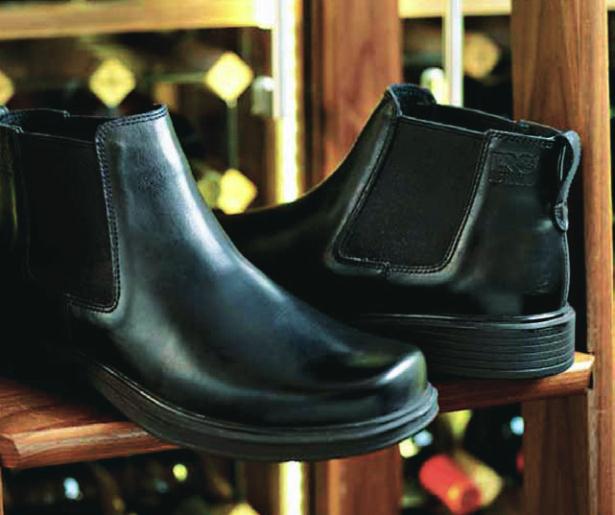
Elastopan Grip Tec and Elastollan Soft are used by
Timberland for the PRO range.
Compared to materials such as rubber, PVC or EVA,
these two compounds show clear advantages in terms of
better long-term flexibility, tear strength, resistance to
puncturing and hydrolysis, as well as flexibility over a broad
range of temperature scales. Both bond well mechanically
and chemically without any auxiliary agent or pre-treatment
when direct moulded onto the shoe bottom. Processing is
straightforward and uncomplicated, which also helps to
reduce costs compared to alternative materials.
Elastopan Grip Tec is in fact a new compound that
features a chemical composition that has been shown to
offer the very best resistance to slip on icy surfaces
compared to other soling materials. It also has the
advantage of up to 30% less density compared to standard
rubbers, so the overall weight of the shoe immediately
becomes lighter with all the benefits to the wearer that
implies. As far as Timberland is concerned, it must feel it has
the best of both worlds, with materials for its soles that do
exactly what they want them to do and a supplier able to
develop and supply them to a high quality standard—clearly
no slip-up in this instance.
PU WELLIE BOOTS
Now that PU has become firmly established as a soling
material for work boots, it is being increasingly used in
‘wellington’ boots. This type of boot has traditionally been
made using either vulcanised rubber for better quality
products or, more recently, PVC for lower priced examples.
Both are heavy to wear and have poor insulation
properties, making them either very hot or very cold
depending on the time of year. The machines used to
produce them have low outputs due to long cycle times
caused by the vulcanisation process in the case of rubber
and the cooling time needed for PVC. Pioneered by Desma,
they are being increasingly moulded in polyurethane which
offers some significant advantages.
25
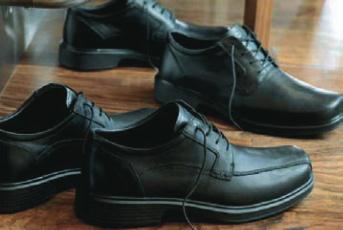
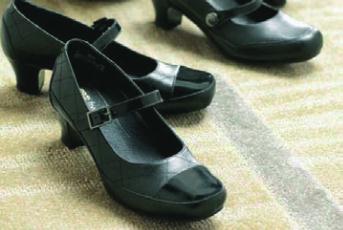
Footwear from Timberland’s PRO range.
IMAGE: BEKINA