This is a SEO version of wfjulaug2011. Click here to view full version
« Previous Page Table of Contents Next Page »THE MOVE INLAND WILL CONTINUE
11
campaign to spread the benefits of industrialisation around the country, but it’s the all-too-real upward spiralling wage levels that have made it happen. Further north, but still on the coast, manufacturers in Wenzhou in Zhejiang province have said they are finding it difficult to make any money from footwear production because of increases in the cost of labour and materials.
Confirmation of the change came in June when Pou Chen, one of the biggest producers of footwear in the world, confirmed that its production landscape was changing and that the changes are deliberate. Chairman of the group, Tsai Chi-chien, told a shareholders’ meeting in mid-June that Pou Chen has a strategy in place to relocate its production base from coastal provinces to inland areas, as well as to countries outside China, in response to high labour costs. He said the movement of production would be completed during 2012 and that, after this, the company will have a brand new production landscape.
New locations
Inland production centres include factories in Jiangxi, Hubei, Hunan, Anhui, and Henan. In addition, the company has also been expanding its production bases in Vietnam and Indonesia. A new plant in Bangladesh has been inaugurated. To stick to China though, there is another link to the new manufacturing locations listed above. It’s linked to their being inland from the real growth hot-spots, but these provinces all feature in the bottom half of the table China’s National Statistics Bureau has compiled to show the gross domestic product (GDP) of different parts of the country. There are 31 places on the table, with metropolis-status mega-cities Shanghai, Tianjin and Beijing occupying slots one, two and three. Shanghai’s per capita GDP was almost $11,000 in 2010, a figure that is
246% of the national average. Guangdong is in seventh position and the other centre of footwear
manufacturing we have mentioned, Zhejiang Province, is ahead of it in fifth. Fujian, another great footwear manufacturing province is tenth in the table. With the exception of the national capital, all of the provinces and cities mentioned are on the coast. They have all experienced great growth in prosperity in recent years, but high labour costs have come along with that. In contrast, Jiangxi, Hunan, Anhui, and Henan, all provinces that form part of Pou Chen’s production plans, occupy positions 24, 21, 27 and 20 out of 31 on the table. Hubei is an exception, coming thirteenth on the list, but still with a per capita GDP that is 37.7% of Shanghai’s.
Global standing
The Pou Chen group is proud of its standing in the global footwear industry. In 2010, it produced 287 million pairs, an increase of 16.4% compared to 2009. In the first quarter of this year, its output was 82 million pairs, which is 27.1% more than the first quarter of 2010. The group manufactures shoes for 60 international brands, including all the big global sports brands. The global athletic shoe market is worth an estimated $65 billion a year; Nike’s most recent annual return on footwear was $11 billion and it claims to have 17% of the market. Pou Chen’s claim is that fully 20% of that global total, which is to say $13 billion, comes from shoes that it makes (including production with joint-venture partners).
Those are retail prices, of course; 53% Pou Chen’s $5.8 billion revenues in 2010 came from making athletic shoes. Casual and outdoor shoes accounted for 16.3%, soles and components contributed 9.1% and sandals 1.1%. But more than 20% of Pou Chen’s turnover comes from its own retail operations now.
Pou Chen believes that 20% of the $65 billion the athletic footwear industry generates each year comes from shoes it has made.
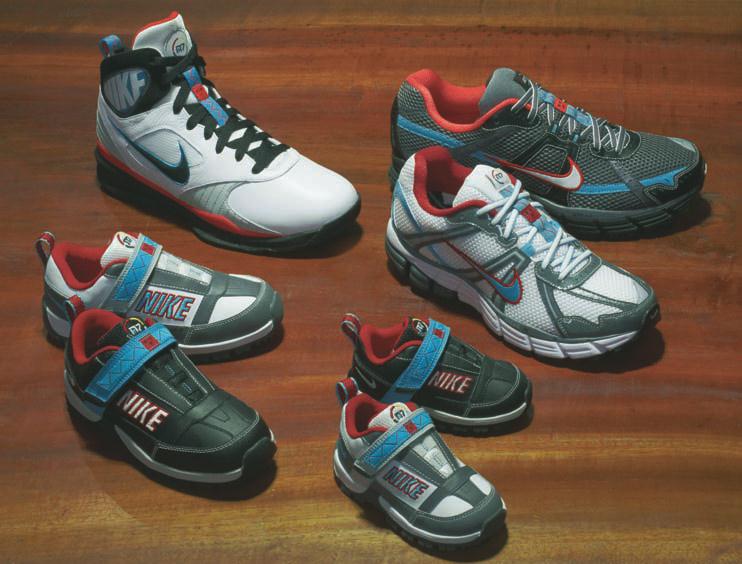
CREDIT: NIKE
This is a SEO version of wfjulaug2011. Click here to view full version
« Previous Page Table of Contents Next Page »