This is a SEO version of wfjulaug2011. Click here to view full version
« Previous Page Table of Contents Next Page »period 2007 to 2013. Its specific goals are to gain leadership in key scientific and technological, to stimulate creativity and excellence, to develop and strengthen “the human potential” of European research, and to enhance research and innovation capacity throughout the continent. Its broad objectives have been grouped into four categories: cooperation, ideas, people and capacities. In the overall context of the EU, for each of these, there is a specific programme, with a wide number of projects within each programme, each claiming a share of overall funding worth €51 billion.
Robofoot clearly represents only a tiny proportion of this, but many in the footwear industry are optimistic that it can make a difference. The project will introduce a number of robotised solutions to a range of operations that are currently carried out manually. The different companies involved have formed a consortium and will share ideas and the findings of their research among their partners and then with the wider industry.
Basque Country-based Tekniker believes that there is comparatively little automation in the footwear industry compared to other sectors to which it contributes research, including automotive, the steel industry and food manufacturing. These other sectors are “strongly roboticised” according to Tekniker, whereas the footwear industry “still uses, even today, artisanal methods for some of its processes”. The research centre’s explanation of this situation is that making shoes involves a high number of variables in the production and assembly process. The organisation is firmly convinced that robotics can help shoe manufacturers overcome some of the complexity they face through having to make so many different stock-keep units (so many different styles, sizes and colours, and often a handful of each, but no more than a handful, in a customer’s order).
Robofoot has just less than two years to run now. Over the course of the project, Tekniker and its partners have said that they intend to increase steadily the number of
EUROPEAN ROBOTICS PROJECT MAKES PROGRESS
25
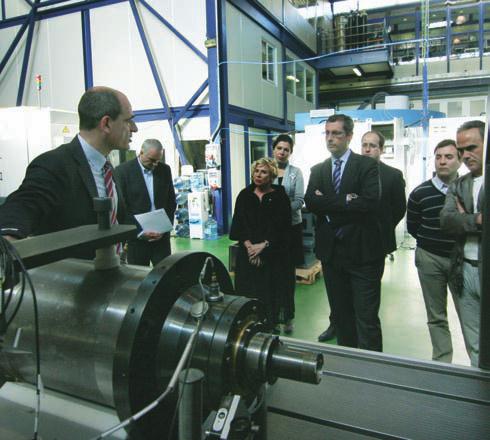
Basque politician Markel Olano (centre) visits the Tekniker-IK4 headquarters in Eibar.
CREDIT: TEKNIKER-IK4
• Pikolinos, Elche, Spain: maker of fashion shoes for men, women and children. Emphasis on natural materials and comfort. • Guglielmo Rotta, Sommacampagna, Verona, Italy: maker of high-end women’s fashion shoes.
• Tekniker-IK4, Eibar, Basque Country: research institution, specialising in automation. • Inescop, Elda, Spain: research institution, specialising in the footwear industry. • CNR-ITIA, Rome, Italy: research institution, specialising in industrial technology and automation.
• DFKI, Kaiserslautern, Germany: research institution, specialising in robotics. • COMAU, Turin, Italy: technology provider, specialising in advanced manufacturing systems.
• QDesign, Pisa, Italy: technology provider, specialising in robotics.
• Robotnik, Valencia, Spain: technology provider, specialising in robotics and automation.
• AYCN, Elda, Spain: technology provider (a spin-off from Inescop), specialising in automation systems.
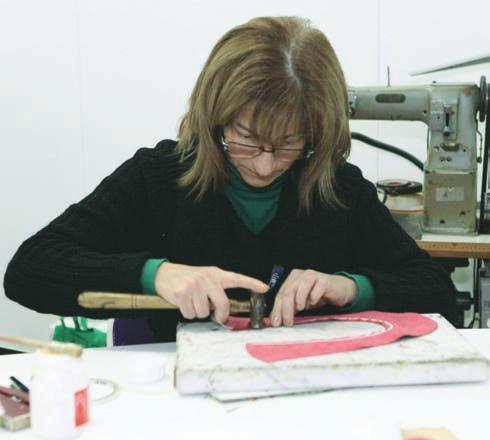
Fashion footwear manufacture still relies heavily on manual labour and craftsmanship. CREDIT: MICAM
ROBOFOOT PLAYERS
This is a SEO version of wfjulaug2011. Click here to view full version
« Previous Page Table of Contents Next Page »