This is a SEO version of wfjulaug2011. Click here to view full version
« Previous Page Table of Contents Next Page »33
Tannery owners talk
In April 2011, our sister publication, World Leather , carried out visits to China and prepared detailed reports on two of the country’s biggest and most prominent tanneries, both of which are important suppliers to domestic footwear brands. These two tanneries, Gansu Hongliang Leather and Xingye Leather Technology, are finalists in the 2011 Tannery of the Year competition.
Xingye is located close to the busy leather production hub of Jinjiang City in Fujian province. It is one of around 50 tanneries in the town, but stands out because of its pioneering work in environmental protection. Company chairman, Wu Huachun, said in the report that he believes footwear consumption in China at the moment is around 1.8 pairs per year for people living in cities and, perhaps, one pair for people in rural communities. He agrees that a doubling of this total in the next four or five years is likely. Mr Wu says: “It will be an enormous number, perhaps an extra two billion pairs a year, and China’s production of leather will have to increase. Yes, sports shoes may use only 25% leather and 75% synthetic materials, and that trend will continue, but casual shoes will continue to use leather.”
This may explain why his company is in the process of doubling up on capacity. It is building new facilities a few kilometres away from the site and hopes to be able to achieve a total output of ten million square-feet of finished leather, mostly for sale to footwear manufacturers, per month within four years. This building work has begun, indicating that Xingye is confident enough of a huge increase in demand from its footwear customers to have made this capital investment in extra capacity.
Recent results from a number of domestically-focused footwear brands also support the predictions of growth. Aokang Group, which manufactured around 17 million pairs of shoes in 2009, now has three footwear manufacturing centres, two research and development centres and more than 3,000 of its own footwear stores across China, in which it sells its shoes under the Aokang, Kanglong, Meirie’s and Redess brand names. It has announced plans to float on the stock exchange to raise capital for further expansion. Rival group Belle International is already a public company. It reported net income growth of 35.2% year on year to $523 million in 2010. Total from footwear sales in 2010 was $2.2 billion, up from $1.8 billion in 2009. Belle operates five manufacturing bases—in Shenzhen and Dongguan in Guangdong province, Jianhu in Jiangsu province, Zigui in Hubei province and Suzhou in Anhui province—and has a total capacity of around 25 million pairs a year at the moment.
Ten times the capacity
Another public company, Yue Yuen, has ten times that capacity. And although many of the shoes it makes are as an outsource manufacturer for big name sports and outdoor brands in North America and Europe, and a large proportion of 286.4 million pairs of shoes were for export to those markets, its Pou Sheng subsidiary is focused on making and selling shoes in the domestic market. The company’s senior management said in the 2010 annual report that increasing consumer spending in China makes them optimistic about continued steady (rather than spectacular) growth for Pou Sheng, which currently operates 3,956 retail outlets of its own across China, as well as supplying 4,218 “sub-distributors”. Xingye’s Wu Huachun makes the important point that 50% of the shoes produced in China, by Yue Yuen and other manufacturers, go for export at the moment. But he thinks this has to change for the simple reason that China is going to need more of the shoes it makes for consumption on the domestic market.
His rival for the title of Tannery of the Year for China in 2011, Li Chen, takes a similar view. The tannery Mr Li founded and runs, Gansu Hongliang Leather, is in a much more remote region in the north of China for reasons of proximity to important domestic sources of raw material, but he recently opened a new finishing plant in the much more footwear-focused Guangdong province and regards himself as being close to the main players in the Chinese shoe industry. His specialism is supplying shoe upper leather to the makers of women’s fashion footwear.
NEW NUMBERS FOR CHINA’S SHOE REQUIREMENTS

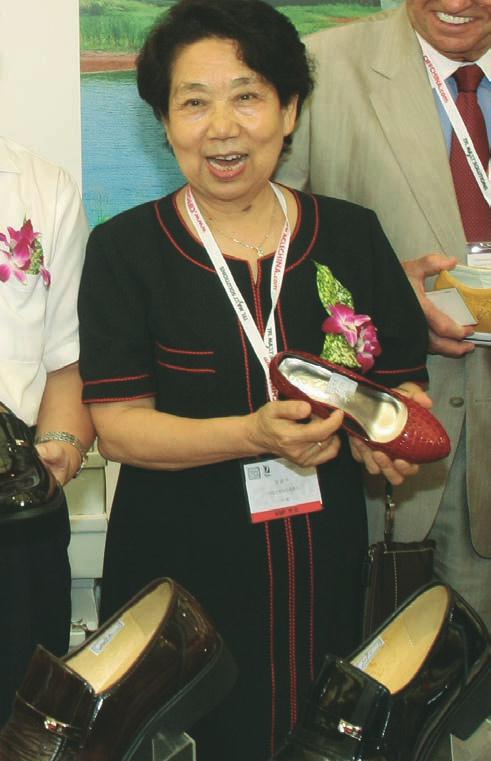
Madam Zhang Shuhua, president of the China Leather Industry Association, has said footwear consumption in China is going to double. Questions as to how many shoes that means and how suppliers will cope remain unanswered.
CREDIT: ALL CHINA LEATHER EXHIBITION
This is a SEO version of wfjulaug2011. Click here to view full version
« Previous Page Table of Contents Next Page »