Basic HTML Version



J&V has been producing shoe lasts
for some 80 years. Back then, all lasts
were made from hard woods which
would vary from country to country
depending on what was most readily
available. Today, they are all made
from
polypropylene
which
is
consistent, does not split and turns
easily during manufacture. Unlike
wood lasts, however, the waste
generated during turning cannot be
burnt in the factory boiler.
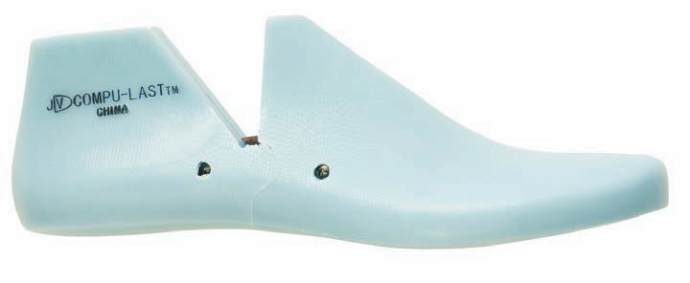
J&V introduced its revolutionary
Compu-Last last system in 1984. It was
the first fully integrated, computer-
controlled last production system that
numerically defined the last, precisely
graded and reproduced it and, at the
same time, guaranteed consistency of
both quality and fit no matter where
the footwear was to be produced. The
system remains at the forefront of last
manufacture to this day.
STARTING TO RECYCLE
With four last factories located in the
U.S.A., China, Vietnam and Thailand,
the company was producing a great
deal of non-biodegradable plastic
waste.
Fortunately,
being
a
thermoplastic polymer, it could be
mixed with new material to mould the
basic blanks from which the lasts were
turned. Although it could only form a
relatively small proportion of the
whole and still produce a strong and
durable last, it was enough to use up
all the scrap generated. This led the
company to use recycled materials
wherever possible, a policy it has
followed ever since.
THE NEXT STAGE
In 1992, J & V formed a partnership
with the manufacturers of Poliyou
open cell polyurethane, to offer a
cushioning system that would provide
the extra foot comfort that wearers
increasingly demanded and, at the
same time, a built-in moisture
management system to reduce
perspiration build-up inside the shoe.
At that time, the uppers of most sports
shoes produced in Asian factories were
glued together prior to stitching in
order to ensure accuracy. This in turn
reduced the upper’s ability to breathe
to such an extent that perspiration
became a major problem. The new
product offered the perfect solution.
It has also proved able to include a
significant proportion of recycled
content and of the eleven products
now available, no less than seven
contain recycled material. Poliyou
contains approximately 70% recycled
material, Bamboo-Poliyou the same
plus bamboo active carbon to improve
moisture
wicking
and
odour
absorption and Poly-Cork Poliyou also
the same but with additional natural
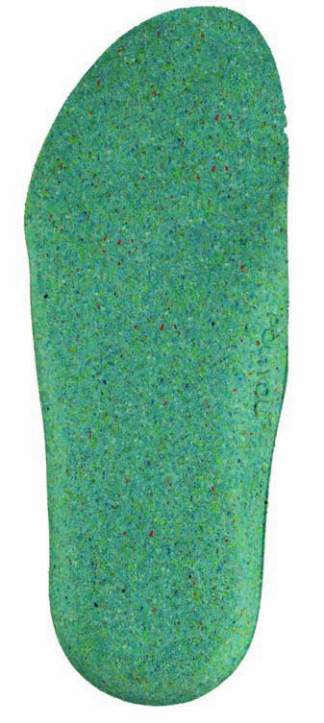
cork granules. Winpad is an
unprocessed Poliyou with recycled PU
foam clearly visible and Polisport, a
high-tensile strength Poliyou with 10%
recycled rubber from used car tyres.
And, finally, the new BioBased
Polisport and BioBased Poliyou
products have a 30% and 10%
respectively soya bean content from
renewable feedstock, in addition to the
recycled PU foam.
Besides providing the company with
a good marketing profile, the use of
recycled open-cell PU foam scrap that
would normally end up as landfill
greatly reduced the volume of virgin
raw material it needed. To give some
idea of just how important this is,
millions of pairs of Poliyou footbeds
are sold every year. So, an
approximately 70% recycled content
means big savings all round.
RECYCLING AS MUCH AS
POSSIBLE
Other products were introduced that
used recycled materials. Among these
were BiFit insole boards and Double R
outsoles. Bi-Fit contains approximately
80%
used
polyethylene
or
polypropylene plastic bottles and
containers that would normally go into
landfill. Rice is one of the most
plentiful food sources in the world.
When harvested, the plant’s husks are
normally discarded. Double R uses
them mixed with natural rubber to
produce
a
sustainable
soling
compound. A new version called Triple
R goes a stage further and includes a
blend of recycled rubber particles as
well as natural rubber and rice husks.
Making these products in China was
a sound decision in more ways than
one. Not only are they produced in the
largest available market, but the
country’s rapid industrial growth has
also made it a huge source of recycled
materials. Indeed, the company is
constantly on the look out for new eco-
friendly materials and processes to
satisfy customer demand for greener
products and, at the same time, stay
competitive.
19
A PIONEER OF RECYCLING
MARCH/APRIL 2012 | www.footwearbiz.com
A polypropylene Compu-Last
containing recycled material.
PHOTO CREDIT: JONES & VINING
The recycled content in Winpad foam
is clearly visible.
PHOTO CREDIT: JONES & VINING