WORLD FOOTWEAR
NOVEMBER/DECEMBER 2011
12
totally committed to competition as long as the
competition is fair, but has alleged openly that that
some of the competition his member companies are
about to face from rivals in China will be unfair.
At the end of September, Mexico’s finance ministry
sent a formal letter to the commerce ministry of China
to ask it to bring to an end a series of anti-competitive
practices that Mexico says some Chinese exporters are
engaging in. According to the Mexican ministry, Chinese
exporters (of products including footwear) have been
using third-party countries to ship goods to Mexico to
distort statistics, playing down the impact December’s
changes might make on domestic shoe production. It
said the cheap prices of some Chinese-made products
coming into Mexico would not even cover the cost of
the raw materials. Its letter to the Chinese ministry was
accompanied by what finance minister, Bruno Ferrari,
called “proofs and specific examples” of these practices.
“We call on the Chinese authorities to bring these
companies to order,” Mr Ferrari said. Mexico has said it
will apply to the World Trade Organization to impose
anti-dumping measures on China if the anti-competitive
practices continue.
Government agreement
Of course, the wider question of removing the 70%
tariffs is something that Mr Ferrari and his government
colleagues have already agreed to. Shortly before firing
this warning shot across China’s bows he made it clear
that his country will not put its “reputation as a serious
trading partner” in peril by going back on the
agreement to end tariffs on imports of Chinese shoes at
the end of 2011. “It’s not in our interests as a nation to
go back on what we have promised,” Mr Ferrari said at
a meeting with senators at the end of August. “The
timescales are decided and we are sticking to them.”
He pointed out that a policy of open trade in recent
years had seen the value of Mexico’s exports across all
sectors increase from $52 billion in 1993 to nearly $300
billion in 2010, and reiterated the promise that the
government would act quickly if there were evidence of
uncompetitive practice on the part of Chinese exporters,
which he can argue it has already done with the formal
letter of complaint to China.
On the subject of footwear, junior minister Dr Lorenza
Martínez Trigueros has insisted that imports of leather
footwear, which she said constitutes 78% of Mexico’s
own shoe output, will still carry duties in 2012, an
average of 27.5% depending on the exporting country.
She pointed out that this was higher than many
manufacturing nations. Footwear industry observers
immediately pointed out that, because these duties will
not apply to imports from China, they ought to be part
of completely separate discussion.
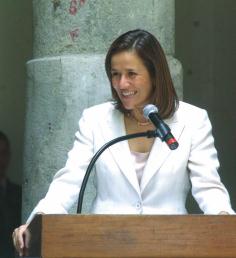
Support from the First Lady
Mexico’s First Lady, Margarita Zavala, has lent her
support to the country’s footwear industry in the face of
the expected forthcoming surge of competition from
China. Ms Zavala has urged consumers to choose
Mexican shoes.
She was a surprise visitor to the Sapica footwear
exhibition, which took place in León in September,
taking time to visit the stands of manufacturers of
children’s shoes in particular. In comments to some of
the exhibitors, she said: “Part of the support we must
show your industry is to buy shoes made in Mexico and
MEXICO’S SHOE INDUSTRY BY NUMBERS
Number of companies in the Mexican footwear industry
7,981
Production
244 million pairs per year
Consumption
285 million pairs per year
Average per capita annual consumption
2.5 pairs
Exports
18.7 million pairs
Imports
58.6 million pairs
Jobs in footwear manufacture
137,885
Jobs in footwear supply chain
275,770
Jobs in footwear retail
158,263
Margarita Zavala, Mexico’s First Lady, has lent her support to
the domestic footwear industry.
CREDIT: LUISADB/WIKIPEDIA