WORLD FOOTWEAR
SEPTEMBER/OCTOBER 2011
explains the name of the footwear brand.
On his return to France, he continued
working at the facility in Limoges until a
chance meeting at a horse-race with a Paris
dandy named Viard led to a move to the
capital and the first J.M. Weston shop there
in the Boulevard des Courcelles in 1922,
followed ten years later by the opening of
the brand’s flagship store on the Champs-
Elysées. The company now has own-brand
stores in fashionable areas across central
Paris, as well as in London, Shanghai,
Brussels, Tokyo, New York, Moscow,
Beverley Hills, Hong Kong and a long list of
other cities in Europe, the Middle East and
North America.
Production values
The traditional Blanchard values also live
on in the way J.M. Weston shoes are made. To
this day, workers in the company’s factory in Limoges
use the techniques Eugène Blanchard brought back
from the US and each shoe is handled between 150
and 190 times during its construction. A designer’s
drawing defines the last construction, skilfully carved
in the traditional way from wood. Several hundred
types of leather are available for the craftspeople to
choose from, including crocodile and other exotic
materials, although calfskin and bovine leather from
les Tanneries du Puy and a number of other high-
quality French tanneries are the favourites. Cutting,
stitching and punching in the brogue design’s holes
are all activities that are carried out or controlled by
hand; other interesting touches include an initial W
being formed by nails hammered into the sole, and
markings that show the width as well as the size.
Marching orders
For more than 40 years, J.M. Weston has been the
supplier of boots to the Republican Guard of the
French Gendarmerie, the unit responsible for guards of
honour (for which the correct footwear is
de rigueur
).
Each officer has the right to a new pair of Weston
boots every two years.
Care and attention shine through in all the
company’s finished products, which is why the brand’s
fame has spread to all parts of the world. Controlling
the quality of the materials it uses in its shoes is part
of this, which is why Groupe EPI wanted to make sure
the leather Les Tanneries du Puy produces continues to
be available.
On leaving the court after the July decision that
gave Groupe EPI the right to take over the tannery,
Denis Lemercier said: “The [70] workers at the
company [Les Tanneries du Puy] can turn a new page
now, one that points towards the future. Our interest
dates back to 2006 when, with Hermès, we decided to
help the Les Tanneries du Puy. We [J.M. Weston] have
already spent more than 30 years maintaining the
exceptional
savoir-faire
of a separate small veg-tan
tannery near Limoges. The expertise of that small
tannery has allowed it to win recognition as a part of
our living heritage. I have the same ambition for Les
Tanneries du Puy, and what we have to do now is for
everyone to join forces and get to work.”
12
The two ancient French towns where J.M. Weston
and Les Tanneries du Puy have their headquarters
are 380 kilometres apart by road, but a curious
historical detail links them. They are two of only
four cities in France to have given their names to
historic routes on the pilgrim’s road to Santiago de
Compostela in north-west Spain, historic because
they were established by the twelfth century. The
route from Le Puy is called Via Podiensis in Latin,
while the one beginning in Limoges has the name
Via Lemovicencis. Along with the other two historic
French paths, from Tours and Toulouse, they meet
in the Pyrenees, from where the road continues for
another 900 kilometres to Santiago. Down through
the ages, countless tonnes of shoe leather have
been consumed on these roads.
Historical note... linking history...
‘ ’
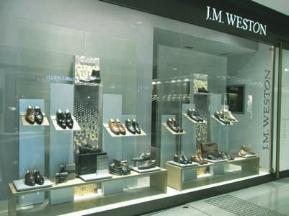
J.M. Weston now has its own stores in fashionable locations
across the world, including Hong Kong (pictured here).
CREDIT: HBOALAMC/WIKIPEDIA