
ADIDAS AWARD MAKES A WORLD OF DIFFERENCE TO ATP
15
with every step helps activate key leg muscles, making
them work harder. The principle is that the pods are
filled with air, which moves from one pod in the heel of
the shoe to one in the forefoot as the heel hits the
ground, increasing the size of the front pod. As you step
forward and roll through the front of your foot, your
leg muscles have to work harder than usual to
overcome the increased volume of air.
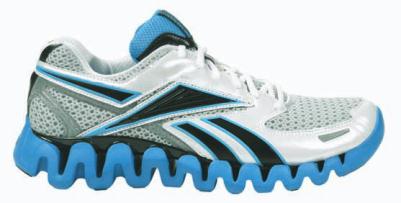
For its part, ZigTech has a distinctive bottom unit that
features what Reebok describes as “an innovative,
lightweight foam that is engineered into a dramatic,
geometric, zig-zag shape”, hence the name. The zig-zag
sole absorbs the impact of heel strike and sends “a
wave of energy along the length of the shoe” to help
propel the wearer forward. This technology causes up
to 20% less wear and tear on key leg muscles, especially
the shins and hamstrings, the footwear brand claims.
In both cases, innovation in the outer sole gives these
shoes their main selling points, but comfort, stability
and foot health are key considerations for the design of
the inner sole of the shoe, making the work ATP does
worthy of this recent recognition on the part of
Reebok’s parent company.
John McCallum, ATP technical sales manager, who
accepted the award at the event in Vietnam, has
explained that the accolade has made a big difference
to his company.
Since becoming involved in the development work for
the Reebok products, ATP has gone from having one
foam system to four and, in May 2010, it was able to add
to its production platform in Asia by opening a factory in
Ho Chi Minh City to complement the one it was already
running in Dongguan, China, expanding from four
production lines to 17. Production has increased from
600,000 pairs a month to more than 2.5 million, and ATP
has been able to branch into midsoling technologies.
ATP has developed a patented process it calls ‘Release
Free’ because mould-release, including silicon, is not
required, making for dry rather than greasy components
and, the company argues, a better look and feel than
moulds made from aluminium, epoxy or steel. The
process is based on 20 years’ experience and, the
company says, allows for high levels of flexibility in a
range of areas.
First, ATP says its master-tooling capabilities are
inexpensive, which make the production of the moulds
themselves cost-effective. With moulds set up, the
production system allows a variety of quantities of
polyurethane foam to be inserted into the same
moulding cavity, meaning ATP can produce a wide
range of thickness in the same insole product. The
pouring system is computerised and can deliver what
the company calls “the precise chemical shot weights”
in increments of a hundredth of a second. Similarly,
different contours of the footbed surface using the
same moulding cavity allow for the anatomical features,
the support areas and the look of the product to
change according to customer needs. Furthermore, ATP
says the moulds can work with a wide range of lining
materials without costly mould modifications.
An important part of the Release Free manufacturing
process is the consideration it gives to tackling waste.
“We’ve created an initiative we call 3-2-1,” Mr
McCallum explains, “in an effort to educate and remind
the footwear industry of the waste involved in
manufacturing insoles using the thermoforming process,
whereby for every two insoles made, the equivalent of
another insole is wasted to landfill. Three are made,
two are shipped and one is wasted.”
The unusually shaped sole of the ZigTech absorbs the impact of
heel strike and sends a wave of energy along the shoe to
propel the wearer forward.
CREDIT: ADIDAS GROUP
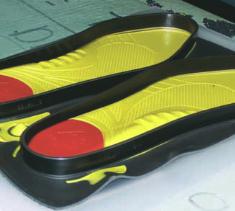
In the groove. Insoles from ATP.
CREDIT: ATP MANUFACTURING