WORLD FOOTWEAR
SEPTEMBER/OCTOBER 2011
travelling to other footwear-producing countries, picking up
ideas for developing his own products along the way. At a
trade fair in Japan, he had a first glimpse of laser-cutting
technology. This made him think that if he had laser-cutting
technology in Farroupilha, he could, for the first time, be
confident of making a line of Sazi machines uniform, each
one made like the next and capable of performing to the
same high standard. He made the investment, and has never
looked back.
Now Sazi produces machinery for footwear manufacturers
in many parts of the world, Europe and Asia as well as the
Americas, and uses eight laser-cutting machines to cut out
the metal parts of its products, an operation that runs over
three shifts 24 hours a day. Folding and shaping and welding
the pieces runs over two shifts, but for painting them, it’s
back to three. The group currently employs more than 400
people on a site covering 11,000 square-metres.
EASTERN PROMISE
Since 2008, Sazi has been working in the Indian market,
training up distribution partners and technical support
operatives there and working hard to convince local
footwear manufacturers that the machines can provide the
service they need in their operations. The company
describes its Indian business as very stable now, having
overcome fundamental issues such as a difference in
voltage. A more difficult challenge was what Sazi describes
as a negative impression of Brazilian machinery suppliers
that had built up in the Indian market owing to poor service
from companies that attempted to establish themselves
there at the start of the century but had failed to follow up
on some initial interest from Indian shoemakers.
Sazi’s commercial manager, Edson Borzoi, remembers
being intrigued by a neighbouring stand at the India
International Leather Fair when his company started to
exhibit there. “There was just a black cloth covering
something up,” he says. “We wondered for ages what it was
and then, eventually, two Indian gentlemen came along,
took the cover off and unveiled two footwear machines
from a Brazilian company. The machines weren’t ours, but
there we were with our Brazilian flag. Our distribution
partner, who is Indian, told us that the two men were Indian
footwear manufacturers and that they had a sign up urging
their colleagues not to invest in Brazilian machines because
the service was so poor. That left a big impression on me,
but I think what it shows is that India represents a
demanding market, that people there are serious and
expect a lot in return for their investment, and that suppliers
deliver what they promise.”
He feels Sazi has benefited from inviting technicians from
India to spend a month at the Sazi factory in Farroupilha
getting to know the company and its products intimately.
INTELLIGENT DEVELOPMENT
In 2006, Sazi carried out a trial of its first machines under
a system it decided to call Intelligent. Working with
academics and industry experts, it came up with the
Intelligent concept to try to create a commercial advantage
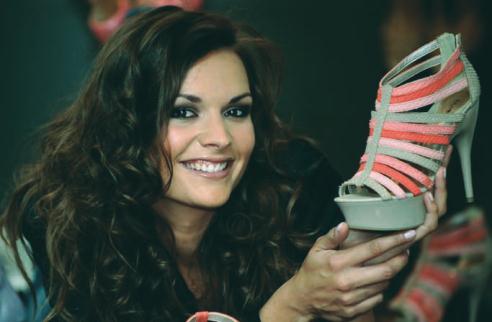
Brazilian shoes at a recent edition of GDS. Energy savings have convinced many top brands to use Sazi machinery.
CREDIT: GDS
32