Basic HTML Version



SOURCING & SUPPLY CHAIN
WF
10
T
he first World Footwear Yearbook report, which
APICCAPS produced in September 2011, put global
production for the previous year at 20.18 billion
pairs, including shoes made from all types of material.
In manufacturing terms, China is the clear leader, with a
production output that APICCAPS puts at almost 12.6
billion pairs in 2010. India is second on the list, with just
over 2 billion pairs manufactured, followed by Brazil
with 894 million pairs, Vietnam with 760 million,
Pakistan with 295 million and Thailand with 245 million.
Other countries making more than 200 million pairs of
shoes a year are Mexico (244 million) and Italy
(203 million).
Naturally, in the months since the yearbook’s
publication, these figures have provoked considerable
debate. Our follow-up dialogue with APICCAPS suggests
that the figure for China, which accounts for 62.4% of
the total, comes from a declared figure from the China
Leather Industry Association for exports of leather shoes
of just over one billion pairs in 2010 and an APICCAPS
calculation of 2.6 billion pairs as the size of the local
Chinese market, for which most shoes are produced
domestically. We have seen no figure for exports of
non-leather shoes from China, but APICCAPS insists its
research shows exports of leather footwear to be 10%
of total shoe exports, which would make 10 billion pairs
the combined figure for leather and non-leather
footwear exports. Add this to the APICCAPS estimate of
the domestic market and it arrives at a total production
figure for China of 12.6 billion pairs in 2010 and, from
that, its global total exceeding 20 billion for the first
time.
Per capita consumption
Whatever the accuracy of the figures, consumers
clearly love shoes. Further analysis reveals that Spain
and the UK have the highest per capita consumption
figures. Both are struggling to achieve economic growth
and have governments urging caution and austerity. In
the case of Spain at least, financial problems are
attracting serious concern from many observers of the
global economy. Nevertheless, the APICCAPS report
suggests that, on average, people in Spain bought 9.3
pairs of shoes each in 2010, 427 million pairs in total.
The UK consumed 504 million pairs that year, with each
person in the country buying an average of 8.1 pairs of
shoes. The US came third, buying an average of 7.5 pairs
of shoes per capita (and consuming 2.3 billion pairs of
shoes), followed by France, where people bought an
average of 6.3 pairs of shoes each during 2010 (and
consumed 415 million pairs during the year).
Japan consumed 693 million pairs of shoes during
2010, or an average of 5.4 pairs per capita. Germany
came next, consuming 385 million pairs and buying an
average of 4.7 pairs each. Brazilian people bought an
average of 4.1 pairs of shoes per capita, while, of the
big ten shoe-consuming countries, Indonesia, China and
India bought the fewest pairs per capita, at 2.6, 2.0 and
1.7 pairs respectively. The figures include all shoes
bought in each country in 2010; there is no way of
knowing how many pairs were bought by visitors to,
rather than citizens of, the country concerned.
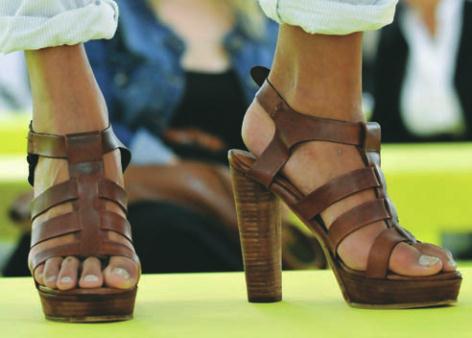
Experts suggest 12.5 billion square-feet of finished leather
went into footwear in 2011
CREDIT: GDS/CONSTANZE TILLMANN
State of the global
footwear industry
As footwear manufacturers look ahead to what 2012 might bring, we review the current
situation in the industry, examining the varying levels in different parts of the world of
footwear production and consumer demand for shoes.