Basic HTML Version


MANUFACTURING & MATERIALS INNOVATION
WF
16
G
erman machine manufacturer Desma has always
been a major innovator, particularly in the field of
PU and TPU moulding machines. While the basic
technologies of injection moulding as a process are long
established, refinements continue to be made to increase
the capability, output and flexibility of these complex
machines. At the Center for the Polyurethanes Industry
(CPI) Conference in September, Christian Decker,
Managing Director of Desma and Bjoern Dormer, Manager
of the Technical Department, outlined two of the latest
developments.
EFFICIENT MOULDING OF
THERMOPLASTIC SOLES
Flexibility in the production of TP (thermoplastics) and
TPU (thermoplastic PU) soles for footwear is influenced by
the time needed to affect changes in the material itself,
whether they are of colour or some other property. A
frequent requirement for small lot production means these
changes must be made with as little delay as possible and
with a minimum of waste as both have a serious impact on
the overall cost of production. Desma has now developed a
new process with limited time and material loss within the
change of the colour and/or additive of the TPU and/or the
compound itself.
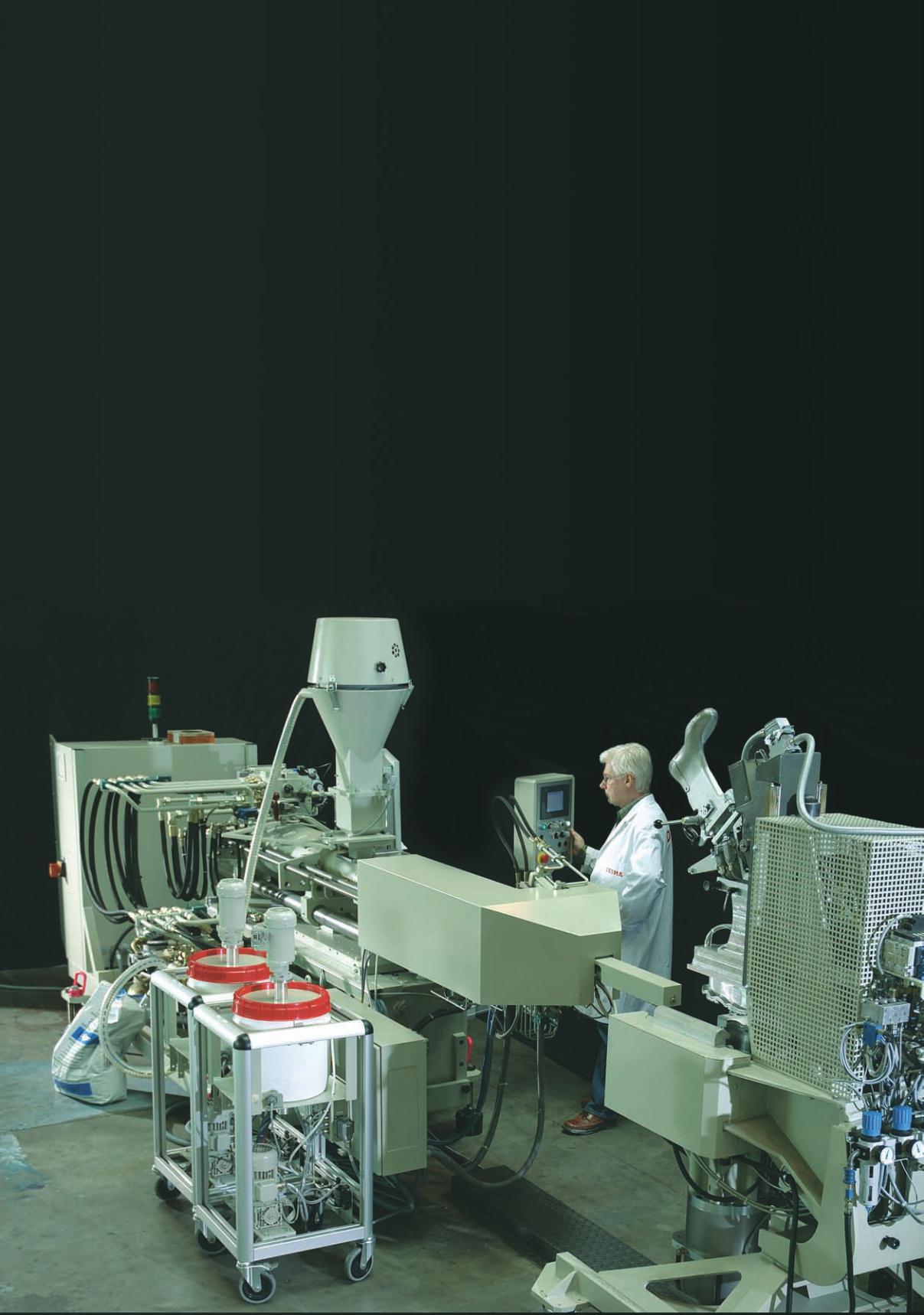
During the plasticising of the compound, the liquid colour
paste or additive is injected into it during the hot
thermoplastic phase. The volume of additive is metered via a
special dosing system and at a constant percentage using a
dosing unit capable of handling four different additives. Re-
circulating these additives between the injecting unit and their
respective tanks guarantees they remain stable and air-free at
all times. To understand how this works, it is best to first see
how the actual processing of TP and TPU is performed.
FLEXIBILITY FROM DESMA
ALL IMAGES: DESMA