Basic HTML Version



FLEXIBILITY FROM DESMA
THE DESFLOW PROCESS
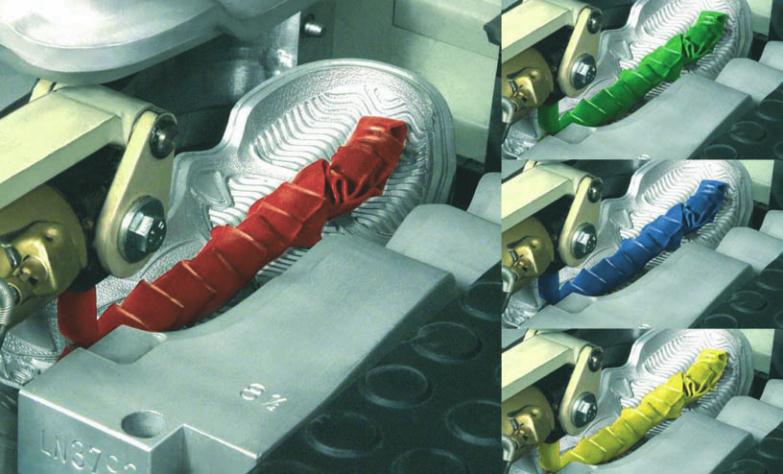
The process used is basically quite simple in that it
involves pouring a hot liquid thermoplast on to the bottom
plate of the mould cavity and then pressing it into the
edges of the mould
(Figure 1)
. A key advantage of this
method is that the TPU is not injected through any runner
channels so no friction is created that would impart
stresses to the material itself. This in turn means that the
final moulded sole has better properties compared to one
produced by conventional injection technology.
Further advantages are that the DESflow principle
creates less waste and that a lower mould clamping force
can be used. As can also be seen in
Figure 1
, the material
is well distributed throughout the mould cavity which
means that it does not have to be forced to flow over the
whole cavity in order to fill it, thus saving cost in terms of
both machine and moulds, and also allowing the latter to
made from aluminium rather than steel.
Another plus point is a reduction in flow marks because
of the better pre-distribution of the material within the
mould as against injection through a thin runner channel
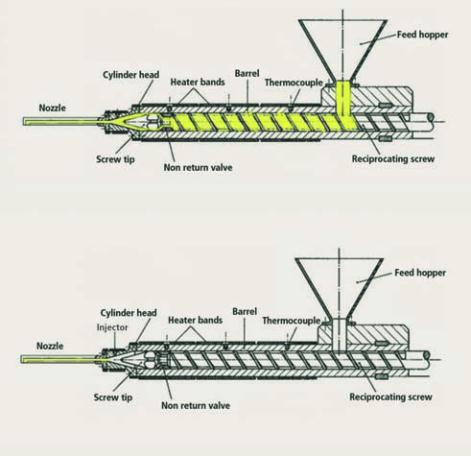
system. Desma also uses a specific type of TPU screw for
smooth heating and plasticising of the compound. The key
feature that makes this possible at high speed is the special
design of the 24D/65mm screw whereby it is both longer
than usual and also has a continuously changing twin
thread zone.
PROCESSING AND VARYING THE
ADDITIVES
The most important factor here is that the additives are
mixed into the melted phase of the TPU and not before. This
gives the producer the flexibility to decide the final properties
or colour of the sole while at the same time using only one
type of TPU. Natural TPU is fed into the main hopper where it
is melted by the special screw described. Once melted and
ready for pouring, it is forwarded to the injection valves of the
additive mixing zone. As it passes this zone, the appropriate
valve(s) open and the selected additive(s) are injected into
the melted TPU stream. Both materials are then thoroughly
mixed and poured into the mould cavity.
Figure 1
also shows
four different colours achieved this way using a single natural
compound.
Up to four different types of additive can be used at a time
and may involve a colour, stabiliser, plasticiser, electro-static
stabiliser, anti-static chemical or even UV-protection. This
flexibility in the additive dosing makes a wide variety of fine
tunings possible. For instance, it is now possible to adjust
Shore hardness so that the shoemaker uses just one Shore
hardness material, such as 50 Shore A, and adjusts it to the
required hardness during the production process.
Take for example, a production run where the same sole
design is required in more than one Shore hardness; at the
beginning of the run a hardness of 65 Shore A is specified
and, later on, one of 45 Shore A. Normally, it would be
17
Figure 2a – Standard TPU unit.
Figure 2b – DESMA TPU unit.
Figure 1 – The
DESflow process.
Figure 2