Basic HTML Version


WORLD FOOTWEAR
JANUARY/FEBRUARY 2012
necessary use two different TPUs, with all the associated
down time and waste involved in purging the screw and
changing over the compounds. This is no longer necessary
as, by merely choosing the right additive, the Shore hardness
can be immediately introduced into the base compound. The
same principle applies to any other additive no matter what
properties are needed.
Another big plus for the system can be seen in
Figure 2
.
In diagram
2a
, mixed material fills the entire length of the
screw as in normal practice. In diagram
2b
, it only fills the
final 450mm and this is what allows the use of natural
material and rapid changes to it with little waste (there is only
about 200 grams of material behind the nozzle), as well as
the independent dosage of additives.
CASTING OF MINI SPOTS
Another area where the need for manufacturing flexibility
has increased involves outsoles and footbeds featuring a
number of different colours and/or technical areas that add
some advantage in terms of performance or comfort. Desma
has developed a new mixing head with special features that
make a previously complex and expensive manufacturing
process much simpler and allows manufacturers to quickly
follow any new trends in the market place.
In the struggle to achieve sales in a tough global market,
footwear manufacturers are continually seeking new ways to
make their products stand out from those of competitors.
Colour and performance are seen as two key areas and ones
that are closely related to the nature and design of the sole.
A further new development from Desma is a micro-
dosing head for small spots or profiles to be cast into the
open mould cavity. With a mixing head having a throughput
of between 1 and 8 grams/sec, it fills an important niche in
the company’s range.
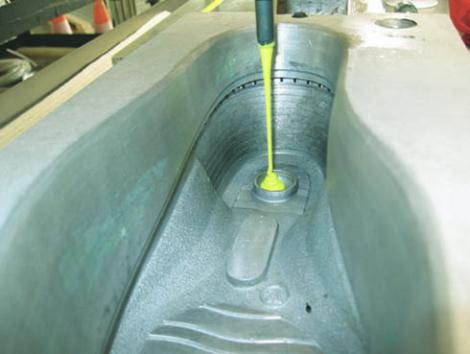
Figure 3
shows the accuracy with
which the robotic micro-dosing head can cast a small PU spot
into the appropriate section of the mould cavity.
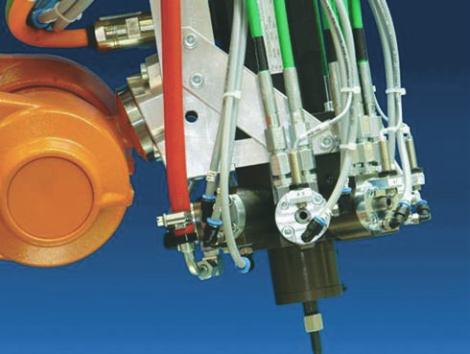
Details of the mixing head can be seen in
Figure 4
where
it is mounted on a six-axis industrial robot. The head itself is
approximately 300mm high and has a rather special
collection of pipes. Accurate control of all the liquids is
essential so the control of pressure within these pipes has to
be quite sensitive. Their small diameter, coupled to the low
overall pressure at which the head operates, makes this
possible.
The specially designed valves, each with its own
individually controlled parameters, provide the option of
individual cycle monitoring which greatly increases the
quality of the end product. Combined with all the other
available parameters of the machine and mixing units, the
shoemaker is offered an extremely broad range of possible
functions. Output on a 60 station rotary machine for a
190gram PU sole with 12gram PU spots is claimed to be 139
pairs per hour as against 259 pairs for 200gram single colour
PU, at 85% efficiency in both cases.
This micro-dosing head can also be used to produce
other products, such as footbeds, or for other technical
applications. The growing popularity of ergonomic footbeds
with different performance areas is creating a natural
demand for small mixing heads for the user of polyester
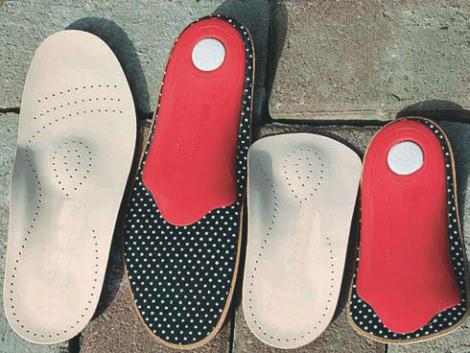
polyurethanes. A good example of this is where one new
product line is using polyurethane gel-technology as a
viscoelastic top footbed support with a high Shore hardness
shank-support underneath and a performance damping spot
at the heel
(Figure 5)
.
18
Figure 3 – Casting a PU spot in a sports shoe sole.
Figure 4 – Micro-dot mixing head.
Figure 5 – Examples of ergonomic footbeds