Basic HTML Version



BUILDING ON EXPERIENCE
21
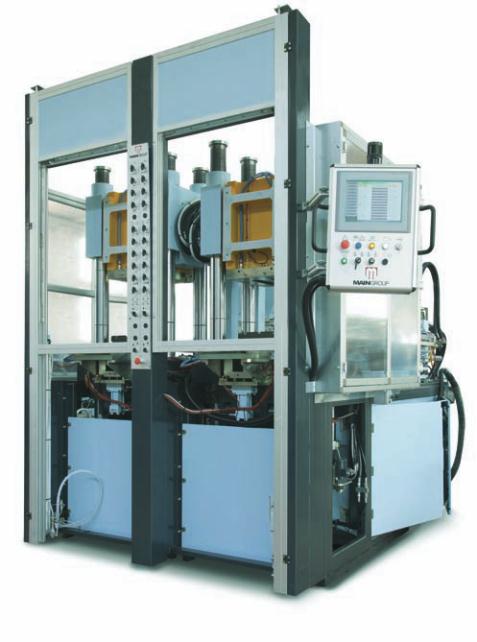
The compact twin station Ross 260T.
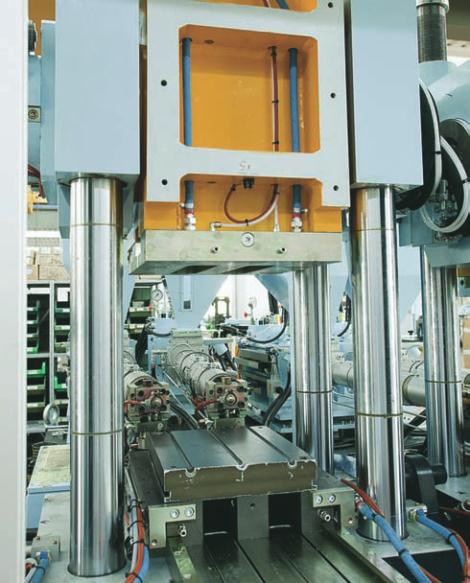
The Ross 260T has 100mm columns.
ROSS 260T
The latest trends for sole units demand thinner and
thinner substance soles, increasingly rigid materials coupled
to ever more complex designs and higher standards of finish.
Needless to say, in the tough conditions of the current global
footwear market these all have to be provided at the lowest
possible production cost. The best material for this type of
sole is thermoplastic polyurethane (TPU) for a number of
reasons. It has a good range of density from 0.50 to 1.25g/ml
and Shore A hardness from 45 to 95. It can also be blown at
densities below 0.60g/ml, retains good properties at lower
densities and, at the same time, is able to combine both good
matt and gloss finishes in the one unit. Its only drawback is
that it is unfortunately the most expensive of the standard
sole moulding compounds.
The 260T (T standing for 260 ton mould clamping
pressure) is the latest in a long and very successful line of
ROSS machines. Earlier examples initially had a clamping
pressure of 130 tons, which was then raised to 200 tons. This
latest increase to 260 tons is designed to meet the high in-
mould pressures created when injection moulding these thin
sole units in relatively high viscosity TPU and, at the same
time, allow larger size moulds to be used to produce complete
sandals or shoes. It remains a twin station machine and can
handle either one or two colour mouldings.
The squared head mould holder version facilitates the
production of highly complex sole units and the addition of
inserts either before or during the injection phase. The
massive 100mm diameter columns reflect the 260 ton
clamping pressure used and the 260T is the only machine
currently on the market to have them (60-70mm is the
norm). This mould-holder also offers fast mould changes on
each station without stopping the machine and automatic
adjustment for different mould heights. In a further move to
keep production costs down, the machine can be operated
in a fully automatic cycle by the addition of front and rear
sprue extraction robots without any loss in quality.
The machine’s performance is continually monitored by
its own in-built management software which cannot be
overridden by an operator. It records every machine stoppage
that loses output and the reason why it occurred. This data is
collated in a file which is then sent by LAN net directly to
management, enabling problems to be quickly rectified.
PRAGMA ROTARY
The latest version of the Pragma is available in 18, 24 or 30
station versions and has been designed to process two-part
sole units in either single density PU, dual density PU and PU
or TPU and PU at a high rate of productivity, with faster colour
changing plus the ability to add inserts if required. It can in fact
work with any type of polyurethane-based polymer to produce
footwear complying with EN 344-345 at faster cycle times and
with superior resistance to humidity ageing. It is also
extremely flexible in that it can inject soles direct to the lasted
upper in one, two or even three colours if inserts are used.
Furthermore, it also has a very large mould-holder both in
terms of ring opening stroke, sole plate and last-holder
movement, able to house larger moulds than other standard
machines and up to size 52 continental (16 UK) if necessary.
It also features the latest in electronic hardware and software
systems, together with precise and sturdy mechanics to
ensure good reliability and straightforward maintenance.