Basic HTML Version


REDUCING WASTE
TPM (total productive management)
is a system for a continuous
improvement of the production
process based on zero malfunctions,
defects and quality loss, etc. ALSA has
found that it also helps reduce
environmental impact. For instance,
less idle machine time or rejected
components means more efficient
production and less waste of valuable
energy and raw material resources.
Avoidance, recycling and environ-
mentally friendly removal of waste
also conserves resources. Packaging
used when shipping to customers or
for transportation within the factory is
reused as many times as possible.
Cardboard boxes that are then no
longer of any use are sent to a
workshop for disabled people that
shreds and sells them on as filling
material. In addition, all wastewater is
purified by the company’s own
biological clarification plant before it
returns to the public water system in
the same way that all modern
tanneries do.
Germany’s refuse management
policy operates on the principle that
whoever generates waste takes
responsibility for it and it has proved to
be a good incentive for the country’s
manufacturers to only use high quality
raw materials that produce less rejects
and therefore less waste. Whereas it
used to be a case of simply disposing of
waste, everyone now realises that it
can include valuable raw materials that
can be effectively reused. Avoiding
waste means consuming fewer raw
materials and causing less harm to the
environment, so certified companies
now collect and recycle all of it.
Other ways of improving overall
efficiency include linking details of
customer orders with the production
line, using real-time diagrams that
reflect the current production plan so
that adjustments can be made to
maximise machine utilisation. This in
turn ensures that machine down time
and maintenance intervals are held to
a minimum, resulting in shorter
production lead times and another
saving in energy consumption.
ALSA has taken advantage of every
possible way to increase efficiency and
control costs. At the same time, it has
also managed to keep within strict
European legislation in regard to the
environment and often to turn it to
advantage, something many others
have said was impossible. Well, it
clearly is not and the company has
proved that being environmentally
friendly is not just a worthy pursuit but
also makes good business sense.
As remarked at the start of this
article, globalisation is no longer seen
in quite the same light as it was only a
few short years ago. The truth is that
many in the west have come to feel
that the whole concept was over-sold
by politicians keen to buy votes. They
have seen jobs vanish overseas with
nothing left to replace them or, if they
still have jobs, are seeing their
standard of living being forced down
through fixed or falling rates of pay
and government austerity measures
forced on them by previous over-
borrowing. All of a sudden, the call is
now for either more manufacturing in
Europe
or
some
degree
of
protectionism.
As has been shown in the past, the
latter does not work long term. Neither
will it replace industries that have all
but disappeared; only investment will
do that. And, for those making that
investment, environmental conditions
will be tougher than anywhere else in
the world. Germany, alone among
Eurozone countries, has managed to
maintain a strong manufacturing base
and has done so within those
conditions. ALSA is part of that story.
Could it be that environmental
legislation is a help rather than a
hindrance to manufacturing in
Europe?
24
WORLD FOOTWEAR | MARCH/APRIL 2012
ALSA also offers an AGO option, supplying its
PU sole units with the adhesive pre-applied
and with a prolonged shelf life. (The name,
from the Greek ‘ago’, meaning ‘to lead’ or
‘attract’, was chosen in 1910 by Italian
chemist Francesco Rampichini, when
developing the concept for manufacturing
stitchless or glued shoes.) The adhesive is
applied to a carrier film in much the same
way as adhesive tapes are produced except
that it remains full width rather than being
slit down to smaller sizes. Shapes are cut
from the film and placed into the sole moulds
before they are filled with PU. Because the
latter foams directly onto the adhesive, it
forms a strong and permanent bond.
Furthermore, the layer of adhesive is the
same all over the bonding surface of the sole.
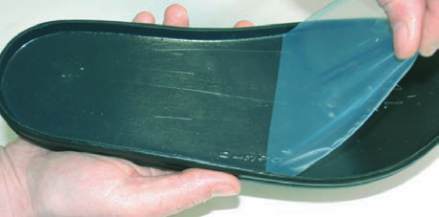
All the shoe manufacturer has to do is to peel
off the film, activate the adhesive and attach
the sole. The process is totally free of
emissions and, because it also saves several
operations, it also reduces costs in terms of
labour and energy consumption.
Removing the protective film.
AN AGO OPTION