Basic HTML Version



DISPLACEMENT
VENTILATION
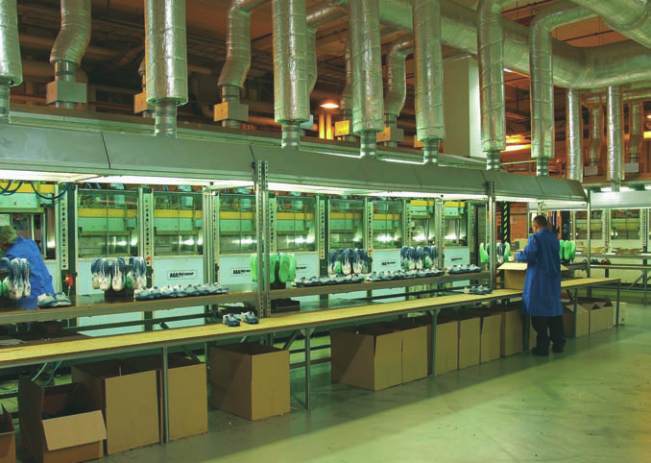
In the polyurethane production area,
a different type of ventilation system is
employed. This one operates on the
principle of displacement flow. Fresh
air is ducted into the production area
at about 3°C cooler than the existing
room temperature. Being cooler, it
distributes itself low down and then
rises as it comes into contact with the
warm machines to be sucked out
through the roof.
Fresh outside air is therefore
available exactly where it is needed
without having to circulate the total
volume of air in the room. Since the
exhaust air installations only work
when the machines do, warm air only
needs to be extracted at that time.
Using this and the heat exchange
system previously described, optimum
employee comfort is combined with a
lower consumption of energy.
REDUCING EMISSIONS
The earth’s ozone layer acts as a shield
against UV-B (cytotoxic ultraviolet
radiation) radiated by the sun and is
damaged by CFCs (chlorofluorocarbons)
and other compounds with a potential for
ozone depletion. ALSA was aware of the
problem long before current legislation
and was the first to foam up polyether
systems for outsoles without using CF or
CHC (halogenated chloro-fluorocarbons).
There are of course many other
harmful air pollutants and the fact that
air pollution in Europe has decreased
over the past 20 years is the result of
ever stricter legislation and a continual
measurement of emissions emergence
and effect. ALSA not only measures air
quality production areas but also avoids
raw materials that might pollute so, for
example, machines used to produce
PUR outsoles all have self-cleaning
mixer heads so that no solvent or water
is needed.
Energy-saving ECGs (electronic
control gears) and LED technology
have also been used to reduce CO
2
emissions.
For
example,
two
combined heat and power plants
provide all the water needed to heat
the machines as well as the electricity
needed for light and power. A
condensing natural gas boiler is used
for general heating purposes while the
factory buildings are designed to be as
thermally efficient as possible.
SPACE TECHNOLOGY
The most recent innovation has
come in the form of four micro-gas
turbines. This pilot scheme, promoted
by the Hessian Federal State
Government, uses technology derived
from space research to deliver energy
for electricity and water at 85%
efficiency in an environmentally
compatible way. The turbines are
fueled by liquid gas and operate at
96,000 rpm which is a similar rate to
that found in the gas turbines used in
aircraft. Emission values are extremely
low and, as all the principal com-
ponents are located on a single
airborne shaft, no lubricating or
cooling agents are required so that
service intervals and costs are held to
a minimum.
Environmental loads are reduced
when the same amount of energy is
generated using less fuel input so it
also costs less. This is another gain in
terms of energy efficiency. Add to this
the advantages to be gained from the
use of low energy lighting and CO
2
emissions fall even further.
23
MANUFACTURING IN EUROPE
MARCH/APRIL 2012 | www.footwearbiz.com
With displacement ventilation, cool rises when it contacts warm machines.
PHOTO CREDIT: ALSA
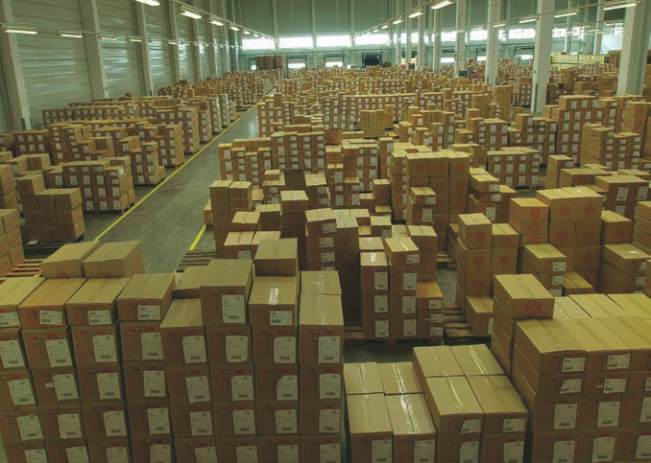
Packaging is reused as many times as possible.
PHOTO CREDIT: ALSA