Basic HTML Version



EPMS
Environmentally preferred materials
(EPMS) play a key part in the company’s
overall business model. Great Lotus
produces its Pedair urethane foams
using the most efficient, health
conscientious and employee friendly
methods. That they are also as
environmentally friendly as possible
goes without saying. For instance, it
uses non toxic ether type MDI
isocyanate to make all its foams. No
harmful gases are released during
production which is safer for the
workforce and better for the
environment.
Right from the very start, recycled
material has been incorporated into all
foam production. This recycled content
includes ground rubber from old tyres
and ground PU scrap. The foam is
carefully formulated to maintain
performance characteristics so that the
physical properties are not affected by
the recycled content. Whilst the
standard regrind content is 5%, as
much as 10% can be offered on request.
By achieving this higher level, Great
Lotus believes that it is the first
company supplying the industry to
achieve this. Foams at this level of
recycled content still meet all required
physical properties and have been
accepted by brand leaders as qualifying
as EPMs.
While many products are straight-
forward single formula foam mouldings,
others are produced by laminating
different formulations and including
foam to fabric for covers, etc. All
laminating operations are carried out
using water-based adhesive, no solvents
are used anywhere in the factory, a
further example of making the product
more environmentally friendly and
reducing the risk to employees’ health
and well being.
NATURAL 30
Great Lotus is also producing open
cell foams using a soy-based polyol
called Natural 30 with similar
properties to those made with 100%
petroleum-based polyol. The current
replacement using sol-based content is
30% but research is ongoing to further
reduce the reliance upon petroleum
based-polyols.
Using soya bean oil does not have a
negative impact on food supply for one
very simple reason. The actual oil is
only some 17%-20% of the total content
extracted from a soya bean when it is
crushed. Apart from a 3% rigid kernel,
the remaining material that is extracted
is protein meal that can be used to feed
livestock. As a result, the more soy
beans are crushed to get oil out of
them, the more animal food for farmers
is produced. Using more oil from soy
beans in fact adds to this food source.
The source of the soya polyol used is
also quite significant: the US. So, why
do this? The answer once again lies in
its
environmentally
sympathetic
philosophy. The supplier concerned is
also highly responsible in the way it
sources its raw materials. A company
spokesman remarks, “We actively work
with our raw material suppliers to
make sure we only use soy farmed in
the US. We do this because we know
that in this region soy is farmed
responsibly and there is no exploitation
of people or destruction of the
environment.”
The Great Lotus factory in Dongguan
was purpose built in 2006 to be
environmentally responsible and
efficient. Its foams and finished
products are also as environmentally
friendly and sustainable as possible
and its management is dedicated to
running its business with these aims in
mind as well as offering its employees
the best terms and working conditions
as possible. There are still those in the
footwear industry who use the excuse
of remaining competitive in a global
market in order to exploit both the
environment and the people they
employ. Whether they will remain with
us long term remains to be seen. Great
Lotus, on the other hand, has never cut
any corners and yet has enjoyed rapid
growth in the very same industry. Who
says a responsible business philosophy
does not pay?
31
STARTING OUT ON THE RIGHT FOOT
MARCH/APRIL 2012 | www.footwearbiz.com
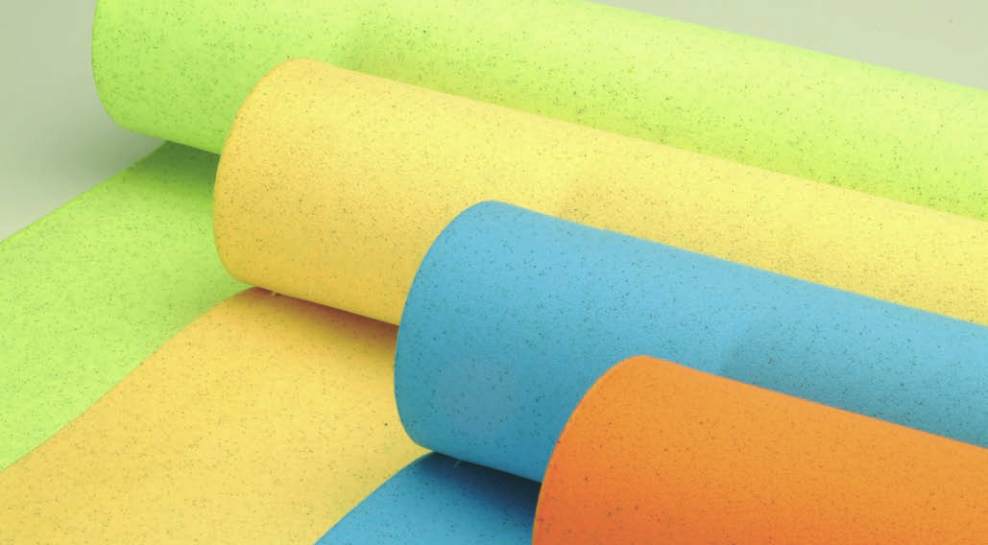
Roll sheet.
PHOTO CREDIT: GREAT LOTUS