Basic HTML Version



33
COMFORT FROM THE INSIDE OUT
MARCH/APRIL 2012 | www.footwearbiz.com
foams, thus using a renewable
resource and reducing the company’s
carbon footprint.
ESD OrthoLite (Electro-Static Dissi-
pating)
was created for use in
industrial footwear and, in particular,
where static-sensitive devices are
involved such as in warehouses and
laboratories. The human body can be a
prime generator of static electricity.
ESD foam safely discharges static and
protects against the accumulation of
electrostatic charges.
X-40
is OrthoLite’s response to a
demand for insoles with higher rebound
properties. It offers a more than 40%
increase in elasticity rating which
provides greater comfort for high impact
activities. This new technology is
claimed to be a first that will reset
industry standards.
OrthoLite Impressions
is the ultimate
memory foam and has been engineered
specifically for footwear to provide ‘step
in comfort’ when first worn and to
mould itself to the foot to provide an
individual custom fit. It is also thought to
be the first open cell foam to be made
with an almost 50% bio oil content.
DO IT YOURSELF
While all that has been said so far is
eminently satisfactory, there must be
something more that really sets the
company apart the others. In fact, there
are several things. The first is the way
that it works closely with its customers,
major brands operating in a fast-moving
consumer-driven market. To satisfy their
needs, OrthoLite has to respond quickly
to any new demand that may arise.
Unfortunately, it found that the big
chemical companies which supply the
polyols used in urethane foams were
simply not able to move fast enough.
CEO Glenn Barrett remarks: “We
understood our customers’ needs. The
problem was that we just could not
obtain new formulations fast enough
from the big suppliers to meet their
schedules. We were caught in the
middle and it was really frustrating. So,
we had to find a solution and the
answer was simple; we make the
polyols ourselves.”
At the same time, consumers were
pushing footwear brands into offering
products with less environmental
impact. A decision was made to build a
factory to produce urethane foams
from bio oil in place of the
conventional petroleum. Extensive
research showed that the alternative
technologies that could produce an
eco-friendly insert without severely
sacrificing
performance
and
consistency of quality were limited.
Opened in 2009, its Dongguan factory
uses one that will as its raw material:
castor beans, a non-food crop that also
thrives under adverse conditions.
As Glenn Barrett goes on to say: “We
now have total control of every facet of
our production from formulating the
polyols we need to meet changing
customer requirements and market
trends to producing the finished inserts.
It means we can promise customers
what they want and when they want it,
with complete confidence”.
PARTNERSHIPS
Another key aspect of OrthoLite’s
success lies in the partnerships it creates
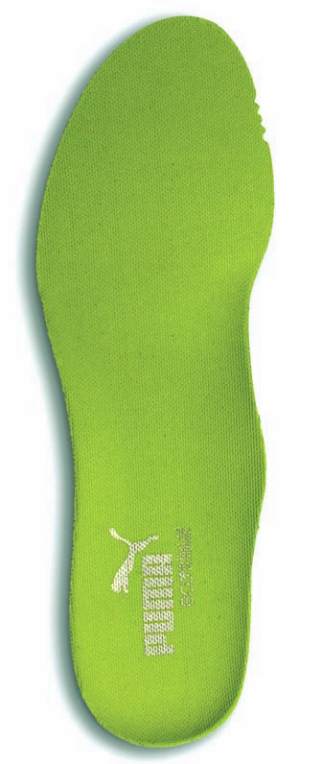
with its customers, sports brand Puma
being a good example. In 2010, Puma
introduced its Sustainability-Index (S-
Index) standard as a benchmark for
sustainable products and setting a goal
of having 50% of its international
collections manufactured to this
standard by 2015, using sustainable
materials and applying best practice
production processes. In 2010, it
incorporated the proprietary Eco
OrthoLite technology into its range of
performance and lifestyle footwear
lines, the first major brand to do so. It
now features in more than a third of the
company’s footwear products.
Bob Michalski, Group Head: Footwear
Development USA at Puma says: ”Eco
Ortholite foam provides enhanced
comfort
allied
to
lightweight,
breathability as well as anti-microbial
and odour fighting capabilities. This
aligns with our product value and
sustainability goals as we're reducing
Puma's carbon footprint, since Eco
Ortholite uses less petroleum.” Clearly a
case of giving the customer just what he
wants.
TAILORING PERFORMANCE
OrthoLite inserts are produced using
multi-stage pressure moulding. This
enables them to be constructed with
different foams in different layers or
segments to meet the individual
customer’s specification. For instance, a
firmer compound may be used in the
metatarsal area of a running insole for
motion control while a softer one will be
used at the rear to absorb heel strike.
The shapes of the mix of higher and
softer durometer foams are strategically
placed for cushioning, stability, etc.,
depending on the application. Industrial
work boots for example will often have
a harder durometer around the heel area
for extra support.
The huge number of possible formula
combinations means that customers’
exact needs can be met regardless of the
footwear concerned. Furthermore, using
different colours for the separate
segments of the insert allows them to
demonstrate to the consumer the
technology that has been built into their
shoes. The fact that over 100 million
pairs of shoes produced each year now
feature its inserts proves that OrthoLite’s
thorough customised approach clearly
works in terms of both performance and
customer satisfaction.
OrthoLite has created highly successful
partnerships with many leading brands.
PHOTO CREDIT: PUMA