Basic HTML Version


feet and calves. The evolutionary biologist of the panel, Mr
Lieberman, had a more unusual perspective. He said that
humans had evolved to run, and have been running
barefoot for millions of years, so to even have the debate in
the first place shows “just how out of touch we are with our
bodies”. He went on to say that humans do “many things we
didn’t evolve to do, such as fly planes and take antibiotic s”
and that therefore whether to wear shoes or not comes
down to personal choice.
Evidence
The lack of scientific evidence for or against barefoot
running makes any debate on the subject more about
subjective opinion than hard fact, which means there are
varying scales across the spectrum. Mr Barthold pointed out
that, from a footwear perspective, the question should be
whether or not athletic shoes positively influence injury — to
which he says the answer is “categorically no”. A study into
the correlation between footwear and injury could shed
some light on this, but such a study would be difficult to get
past any ethics committee.
The lack of scientific information for what causes running
injuries further complicated the barefoot issue, although by
studying the form of barefoot runners, Mr Lieberman
suggested, we can start to get an idea of what factors may
be relevant in injuries. “One of the reasons that barefoot
runners tend not to land on the heel, particularly on hard
surfaces, is that it hurts,” he said. “Whether that is clearly a
mechanism to protect against impact damage, nobody
knows, although there are papers that show there is a
correlation between the rate of loading and the magnitude of
the impact, and running injuries. I think injuries come partly
from impact, partly from running form and I think the reason
barefoot runners tend not to land on the heel is that it’s an
adaptive signal from the body.”
Running form is a key part of the barefoot debate, and
when making the transition from running with trainers to
running without, learning good barefoot running form is
essential. “I worry about people who learn about barefoot
running, and they read stories which don’t really explain it very
well,” said Mr Lieberman. “So they switch to a barefoot style,
and they forefoot strike because they’ve been told to do that,
but they don’t change any other aspects of their running. I
suspect those people are getting injured by the droves. It’s
about how you use your body and that’s where barefoot
helps, because it gives us a set of hypotheses.”
The professor went on to say that scientists today assume
that wearing shoes should be the null hypothesis.
“I would argue from an evolutionary
standpoint that this is the wrong null
hypothesis, just as a more natural
diet, high in fibre, low in
starches and sugars is more
healthy, you might also apply
the same logic to the way in
which people evolved over
millions of years,” he said.
“I should also point out that people have been wearing shoes
for a long time. We know from archaeological records that
shoes are at least 30-40 thousand years old.”
The causes of injury
On the subject of whether or not barefoot or shod running
is better for preventing injuries, most of the experts agreed
that rather than worrying about wearing shoes, avoiding
repitition is the most important thing. Mr Barthold said: “From
an injury preventative point of view, it’s very important that
you introduce things like trail running, some barefoot training,
but wear shoes when appropriate. It’s important to make sure
you’re not introducing the same repetitive pattern time after
time because that’s the reason that runners get injured.”
It was generally agreed by the panel that cushioning in
footwear, although a useful marketing tool, does not actually
have any proven effect on injury prevention. Mr Nigg studied
impact forces when he first started researching biomechanics,
and found some interesting and surprising results. “When we
run barefoot, shod, in soft shoes or in hard shoes, the impact
force peaks are always about the same,” he said. “Which is
completely surprising. When we run fast, the impact forces
increase. But when you run at a certain speed they are always
about the same. That was the point that I came to the
conclusion that impact forces are not a problem with respect
to injuries because otherwise people running fast would get
more injuries than people running slowly. They do not; so it
must be something else.”
The barefoot runner of the panel, Mr Howell, agreed with
this. “Barefoot runners don’t care how hard the ground is, they
care how rough the ground is,” he said. “One of the nicest
surfaces to run barefoot on is smooth concrete asphalt.”
Rather than cushioning in footwear being a helpful tool, it is
in fact the pre-activation of muscles in the foot which helps
reduce the potential for impact forces to cause injury. Mr
Nigg’s anecdote about working with Canadian entertainment
38
WORLD FOOTWEAR | MARCH/APRIL 2012
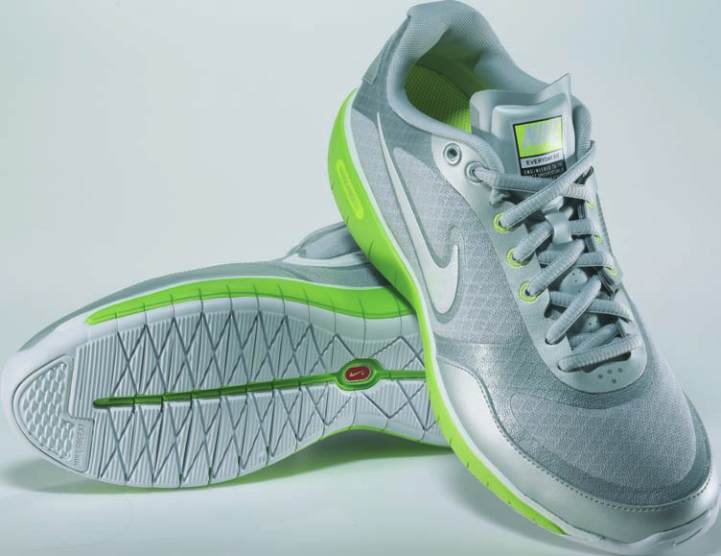
The Nike Free trainers are designed to mimic barefoot running
and, in doing so, strengthen the muscles in the foot.
PHOTO CREDIT: NIKE