used in different types of shoe depending
on their final use. It is even possible to
provide an initial soft ‘try on feel’ for the
wearer which is a strong selling point for
comfort shoes.
Factory shoe inserts are a more
practical way to add cushioning to
everyday footwear. This in turn has led to
a huge range of sophisticated after-sale
inserts becoming available. While shoe
manufacturers can test and select what
they consider to be the best price and
performance materials to use, the
consumer has no such resource and final
choice is influenced by price, availability
and brand perception. They may not in fact
be buying the most suitable product for
their particular needs.
ABSORBING LOADS
A load on the body is generally
transferred to the skeletal system. Soft tissues like skin,
underlying fat and muscle act as a cushioning interface for
the transfer of such loads to the bones themselves. These
transmitted forces have the potential to damage soft tissue
and the critical factor is not simply the force but the ratio of
that force to the surface area over which it acts.
Bone extremities at the heel and ankle are covered by a
relatively thin layer of tissue and, as they support so much
body weight, are critical in terms of support technology. The
support or shock-absorbing systems generally used have
traditionally fallen into three categories.
Solids
- solid cushions such as PU and latex foam or high-
density gel which have a ‘springing’ type action. For various
reasons there is said to be no uniform pressure distribution
over the cross-section but rather an unequal pressure build-
up with the maximum occurring in the centre.
Liquid
- fluid media such as water or gel that have to be
separated from the body by a membrane. The aim of this type
of support is to keep the body ‘floating’ and therefore its
density must be greater than that of the human body (approx.
1000 kg/m
3
). In order to separate the body from the medium,
an enveloping cover is used. Again, there is said to be no
uniform pressure distribution.
Air
- gaseous media (mostly air) in a closed cushion system
which also has to be separated from the body by a
membrane. Even this method has been described as lacking
true uniform distribution due to the tension of the membrane.
At places in the body where the mechanical load on
bone, muscle or other tissue can become too high, bursae
(sacs or pockets filled with synovial fluid) are found. They
occur where muscles, tendons, or bones rub against each
other. They lubricate these points of friction and dissipate
force by distributing it through the synovial fluid present
and normally produce just enough of it to reduce friction by
reducing tissue bonding. From an engineer’s point of view,
the advantage is the fact that it achieves this by actually
separating the moving tissue.
LIQUICELL
One of the more innovative principles for body support is
a bursa-like interface sac called LiquiCell. Developed in the
USA. by Birchwood Laboratories Inc., it closely resembles the
actual bursae found in the human body. It consists of a pouch
containing a low viscosity liquid and one or more baffles to
channel the liquid within the pouch as pressure is applied or
shifted across its surface. The theory is that the shear force
on the body contact surface is very low and that the small
layer of liquid equalises that pressure.
As the volume of liquid used is so small, there is no
pressure build-up due to body weight imprint on the cushion.
Instead, the liquid provides a thin layer of fluid over the entire
contact surface that has a friction coefficient of 0, which is
comparable to that of a layer of ice. The covering membrane
is allowed to move freely with the body, so even a thin layer
22
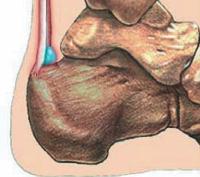
Example of a human bursa.
Retrocalcaneal
bursa
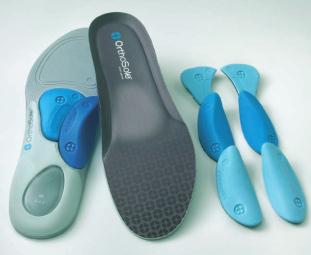
Orthosole footbeds by Athena Pacific have interchangeable
support options.
CREDIT: ATHENA PACIFIC
WORLD FOOTWEAR
NOVEMBER/DECEMBER 2011