
DEFINING FOOT COMFORT
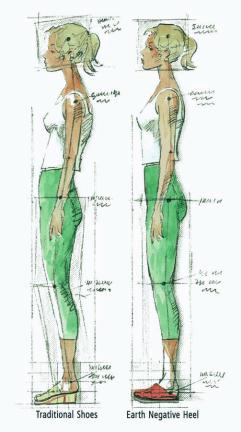
From time to time over the years, shoes with negative
heels have also appeared with perhaps the best known
being the Earth shoe created by Danish yoga master Anne
Kalso. This combines an anatomical plantar surface with a
negative heel so that the rear of the foot is positioned slightly
lower than the rest of the neutral plane sole surface. It is
claimed to be both bio-mechanically and anatomically
natural as the negative heel simulates walking barefoot in
soft sand where the heel sinks lower than the mid and
forefoot. Natural or not, it nevertheless does appear to
improve posture and allow the wearer to stand and walk in
a more upright stance through better alignment of the spine.
STABILITY
Stability during locomotion is important for all age groups
and two strategies can be employed to this end. One is to
strengthen the lower extremity muscles and the other to
construct shoes and inserts that provide proper support for
the feet. Research has however suggested that shoes which
provide stability also cause the muscles contributing to static
and dynamic stability to become weaker as they are no
longer fully utilised.
Another interesting result from this research surprisingly
revealed that there was little change in shock absorption or
motion control in shod versus unclad feet. Indeed, in the case
of runners, wearing shoes deceives the body’s sensory
abilities and reduces reaction time as well as weakening the
lower extremity support muscles, tendons and bones.
BIO-ELECTROMAGNETISM
Ask a panel of experts whether they feel that making a
shoe breathable is a more natural benefit and they would
undoubtedly say yes. Ask them if including a shock-
absorbing layer in the sole added comfort to shoes used on
modern surfaces and, again, they would also agree. Ask them
if it would be more natural to make a shoe lighter or heavier
for use in lifestyle or athletic footwear and the answer would
again be positive. Ask them if feet are in a more natural state
when on a plantarflexed, neutral, or dorsiflexed angle and,
while there might be some debate, they would most likely
settle on a neutral plane as being the most natural.
Now ask them if it would be more natural for the body
(through the feet) to be insulated from the ground’s
electromagnetism or be conductive; there would most likely
be total silence. The body is in fact an electro-chemical
machine and we now know a great deal about these
chemicals in the form of the food and supplements we put
into our bodies. In the footwear industry we have, over the
past thirty years or so, also learned much from studying the
results of biomechanical testing and adapting the results into
shoe function. What we have yet to learn is how to rectify the
inadvertent deprivation of electromagnetic contact with
earth through footwear.
Up until the 20th century, the predominant soling
material used in footwear was leather. This is a natural
substance that is electrically conductive to the earth in the
same way as walking barefoot. By producing almost all
modern footwear with soles made from materials with
insulating properties we have inadvertently insulated
ourselves from the Earth’s natural electromagnetic field with
unknown effects. Can this be termed ‘natural’?
CUSHIONING
Running shoes have been at the forefront in terms of
cushioning shock to the body. This feature has also been
increasingly applied to a broad range of every day types of
footwear. Despite subjective opinion and objective laboratory
shoe testing, opinions still differ widely as to how and why
various cushioning systems do or do not work.
The most common approach is to use a material or
substance that disperses shock. This material is added to the
shoe’s midsole, which is itself a primary shock absorber. Most
running shoe midsoles are made of EVA with occasionally
some additional rubber or polyurethane for greater durability.
EVA is a useful material in that it is available in different
durometer readings (resistance to indentation) to make it
either easier or harder to compress. EVA can also be blended
with rubber to create a midsole with a better energy return.
Midsoles with different durometer readings can therefore be
21
Earth Footwear’s way to improve posture.
CREDIT: KALSO EARTH SHOES