MANUFACTURING & MATERIALS INNOVATION
WF
24
T
he Harman Group with its headquarters in India’s
economic and financial capital Mumbai is a major
player in the supply side of India’s footwear and
leathergoods industry. Its remarkable success has been
mainly due to the singular vision, enterprise and business
philosophy of one man, HK Razdan. India’s footwear industry
has made enormous strides in recent years. Indeed, there are
some who predict that, in the longterm, it could rival China
as a major driving force in the global footwear market. The
Harman Group has played no small part in this success.
Hari Krishen Razdan was born in 1930 to Pandit Mohan
Lal Razdan and his wife Mohini Razdan at Gujranwala which
is now in Pakistan. He grew up there before studying
successively at Farrukhabad, Patiala, Sargodha and Lyallpur
(now known as Faislabad). Although as a Kashmiri Pandit
his mother tongue was Urdu, he learnt both Hindi and
Sanskrit during his schooling and his facility with languages
was to stand him in good stead in the future. He was, and
still is, strongly influenced by the finesse of the Urdu
language and culture, in particular its music and poetry.
He studied physics, chemistry, zoology and botany in
college with the ambition of becoming a doctor. This was
not to be, however, as his academic career was cut short by
the partition of India in 1947 which forced him to leave what
had now become Pakistan and move to what was now the
Republic of India. He found shelter with his married sister in
the ancient Mughal city of Agra where, unable to afford
further studies, he worked as a salesman for his brother-in-
law who made shoe polishes and supplied the hundreds of
large and small shoe factories for which the city was
famous. This proved to be a useful training ground for his
later years in the footwear industry.
STARTING A BUSINESS CAREER
He next moved to the country’s capital New Delhi where,
in order to make ends meet, he took a job as a government
clerk. This did not last long, however, as he felt suffocated by
a dull daily routine where there was no excitement and no
great future prospects for an ambitious young man. He
therefore moved on yet again, this time to Bombay (now
Mumbai) the commercial powerhouse of India and a city of
opportunity. And so it proved to be for him. He became a
salesman for a company importing bicycles from the U.K.
and automotive spare parts from Germany. By 1959, India
was gradually becoming more industrialised and the import
A PHILOSOPHY FOR SUCCESS
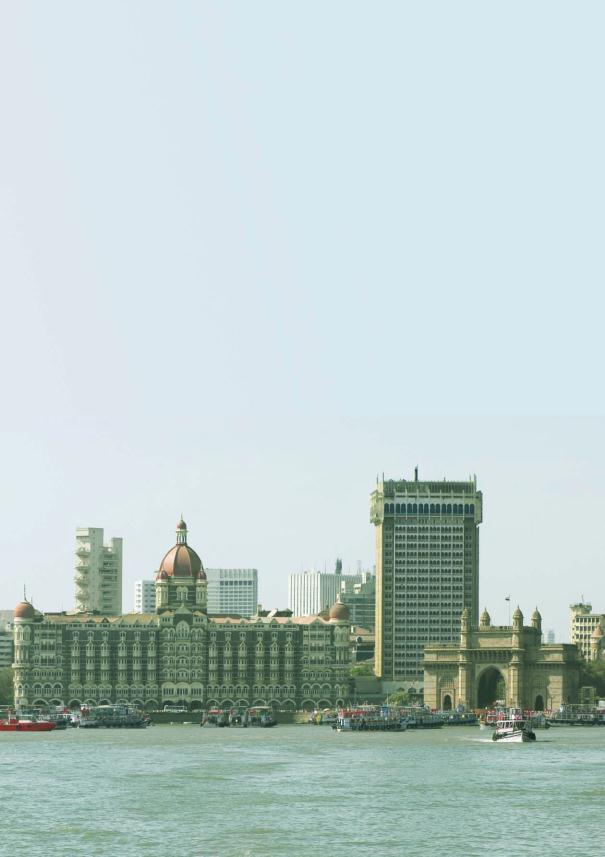
Gateway to a city of opportunity, Mumbai.
CREDIT: SHUTTERSTOCK