MANUFACTURING & MATERIALS INNOVATION
WF
28
T
he first contacts of the shoe industry with the digital
domain date back many years to when personal
computers and graphic workstations first appeared.
Together with the early generations of software systems,
they were aimed at easing, speeding up and simplifying the
work of shoe technicians and designers. Since then, the drift
from the old analogue world reliant on human control,
physical tools and manual operations, has steadily increased
the progressive digitalisation of systems, machines and
processes up to the level we know today.
Computers and electronic digital devices are now part of
our everyday lives and have changed the way in which we
communicate. We share opinions and feelings, enjoy our
free time, and watch, listen, purchase and sell. It’s a digital
world that has become so pervasive that we hardly
remember the analogue world that existed before it. Indeed,
the so called ‘digital natives’ of the younger generation
cannot even envisage this different world and do not believe
there was a time when all these things simply did not exist.
As bits and digits have become part of daily life, so they
have changed the way products are conceived,
manufactured and sold. In the footwear industry, 2D CAD
systems are widely used for pattern engineering and
grading, while 3D CAD software packages allow companies
to cover all the steps of shoe design whether creative or
technical with greater efficiency and consistency and, at the
same time, generate a wealth of data to be used in
manufacturing by NC machines. Dedicated software
applications calculate material consumption, store and
manage project data, plan processes and optimise resource
utilisation. There is now scarcely an area in a modern shoe
factory where digital data are not used to document a
design, model a process, manage a machine or even the
entire manufacturing plant itself.
Production lines have also been transformed by the
advent of digital machines equipped with Numerical
Controls capable of executing pre–programmed tasks and
trajectories based on a stream of digital data generated by
upstream processes. This evolution, started more than
twenty years ago, is now complete and is more or less
evident in virtually all the different machines involved in
footwear production. The most obvious is the revolution that
transformed the traditional analogue method of cutting
upper materials using knives and beam presses into the
digital approach of dieless cutting systems. These are faster,
neater and more flexible, with physical knives replaced by a
digital alternative stored in the memory of the PC or
projected onto the material to guide the cutting process.
SHOES GO DIGITAL
SERGIO DULIO
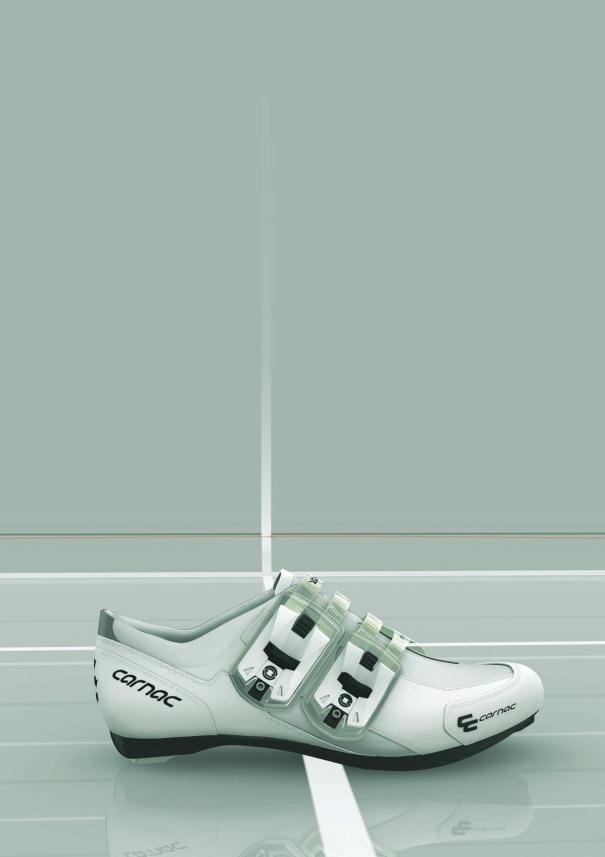
Virtual image of a Carnac cycling shoe
demonstrating the standard of representation
that is now possible.
CREDIT: RTT