
SHOES GO DIGITAL
Most of all this is well known to shoemakers and has
been extensively covered in many articles and publications.
There are other examples of this progressive evolution into
the digital domain that are, at least for now, not so widely
appreciated but that clearly indicate important future trends
for the industry and have the potential to transform it.
REALITY AND VIRTUALITY
Joe Pine, author of ‘Mass Customization: The New
Frontier in Business Competition’ in his most recently
published book ‘Infinite Possibility’, explores several ways to
create customer value on the digital frontier. In it, he
theorises a sort of ‘continuum’ between the real world
governed by the three dimensions of actual time, real space
and matter made up of atoms, and the digital world. In the
extension of the former into the latter, time or no-time as
Pine calls it, becomes independent from the actual time of
our experiences, atoms are replaced by bits as matter
becomes digital and space is no longer real but virtual. His
theoretical ‘multiverse’ sets the frame for a multitude of
different experiences for the consumer in which boundaries
between the analogue and the digital worlds seem to fade
away. Exploiting the potential of this novel theory offers
interesting new business opportunities in ways never
previously thought of.
We are all used to reality as perceived by our senses, with
a clear understanding of the passing of time, the space in
which we move and the physical objects we can see and
touch. For example, when we see a sample shoe, we note its
style, colours and details. In the multiverse, this is the realm
of virtuality as exactly opposite to reality. In this other realm
consisting of autonomous time and no real space to fill,
objects are made of bits and can take shapes and aspects that
go beyond what actually is, or can be, done in the real world.
Returning to more familiar shoemaking terminology, this
is the domain of what used to be known as virtual
prototyping, or the creation of new shoes, that only exist in
the digital world but to an observer look like real ones. The
aim of the exercise is clear: making virtual prototypes is, or at
least should be, much faster and cheaper than making real
shoes. Playing with style, colour or material variants is much
easier than doing the same thing to a physical object and also
offers infinite possibilities to the user.
In the case of footwear, the key point in all this is that the
virtual world must be as real as the real one, such that the
realism of the virtual object must be the highest achieveable.
Every minute detail of the shoe must be reproduced and the
finest textures in its materials modelled so that images taken
from the digital world become indistinguishable from the real
object. These are the pre-conditions needed for the virtual
prototype to replace in all respects the real one.
Software modules to generate such high quality
rendering with, in addition, the possibility of turning, moving
and observing the shoe model from any point of view are
now part of the product offering of all the most important
vendors of shoe CAD systems. Furthermore, development
work is still not finished and promising new advances are on
the way. If we are seeking the utmost, hyper realistic quality,
however, we need to look elsewhere, such as the German
company RTT whose website images from the automotive
world give a clear idea of just how blurred the line between
the real and the virtual world has become.
We must not however think that digital models or, more
correctly, shoes in the realm of virtualty are only made for the
sake of generating high quality pictures. A digital model can
be in every respect the core representation of the product,
from which activities such as product reviews, sales
presentations, promotion and advertising, product
documentation and many others besides can all be derived.
Having said that, the cost in terms of time, tools and
resources of creating it must be as low as possible so that the
gains made in not having a physical prototype are not
overtaken by the extra time needed to create the digital
model itself.
A clear example of a more intimate fusion between the
real and digital world is Augmented Reality. According to
Pine’s theory, this is the realm of true time and space, in
which digital technologies are employed to enhance our
experience of the physical world. So, take the same virtual
prototype and now, rather than seeing it in a totally digital
world, imagine that you can hold it in your hand and move it
freely as if you were handling the real object while, at the
same time, seeing a picture of the real you on a computer
screen with the virtual shoe in your hands. Or, to extrapolate
that a little further, imagine that you can see yourself wearing
the shoe with your actual outfit, by looking into a sort of
‘magical mirror’ that sends back the image of the real you
wearing a non-existent pair of shoes. Virtual try-on systems
similar to this have been developed in recent years. The
Tryon system developed by Italian company SEAC02 is
already operating in the Calzoleria Rivolta flagship store on
Via della Spiga in Milan.
While such systems are still not totally convincing in
terms of appearance and general feel, they do represent a
sure attraction to entertain and stimulate the curiosity of
customers. Their true potential is, however, still largely
29
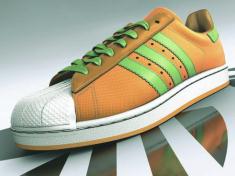
Colour, texture and perspective can all be created to such a
degree that the virtual image appears to have the all the detail
and solidity of the real thing.
CREDIT: RTT