
underexploited and one step forward would be to enhance
the experience with other stimuli besides the visual one by
bringing virtuality even closer to reality and thus expanding
into a further new realm that Pine calls augmented virtuality.
The interest shown by important research centres and
software houses suggests that we can look forward to some
interesting developments in the future.
THE WEB, SOCIAL NETWORKS AND
E-COMMERCE
Staying with Pine, surfing the world-wide-web can be
regarded as another form of virtuality. The Internet is
increasingly the place where people meet, communicate,
socialise, search and share information and, eventually, buy
things. When they do so, there are no real time limits as to
when a purchase is made—some surveys indicate that a great
deal of internet shopping is done in off-time or during the
night—or to where, as there are no limitations as to where
buyer and vendor are located. This fits perfectly Pine’s
definition of the virtuality realm and opens a wide range of
opportunities for smart vendors.
A recent Italian study on developing trends in e-commerce
stated that the most important motivations to buy online are
the possibility to access shops that are open 24 hours a day all
year long, the saving of time in buying there and, last but not
least, the cheaper prices often to be found on the Internet. It is
clear that these considerations offer companies great business
opportunities and the footwear industry has only recently
begun to realise this. Another Italian survey on the highest
growth sectors in the e-commerce world reported a 39%
growth in web purchases of apparel from 2008 to 2009, putting
it in first place and of which footwear formed a significant part.
There are currently several e-commerce sites dedicated
solely to selling footwear including Zappos, Sarenza,
Shoes.com and Spartoo. Between them they sell a great
variety of brands and styles and their double digit growth
and billions of euros worth of sales indicate that consumers
have lost their inhibitions towards buying shoes online and
no longer seem frightened of ordering something they
cannot see and test in a real shop. Shoe dedicated sections
are also included in e-commerce sites for luxury goods like
Yoox while, more recently, Amazon has also realised the
potential of selling shoes online and opened its own Javari
web store dedicated to footwear. We are witnessing a global
trend that would have been barely imaginable only a few
years ago.
At MICAM in September, the Italian Association of
Footwear manufacturers (ANCI) put online its own e-
commerce site named iloveitalianshoes.eu, where a growing
number of manufacturers of the best quality shoes in Italy are
offering their products to potential customers. The site
features a set of services that allows the viewer to easily
search for models, styles, colours and sizes or, if they prefer,
individual brands. Separate ‘shop in shop’ areas allow each
brand to present itself and its products with the typical look
and feel of its own shops. High resolution images with the
possibility of a dynamic, 360 degree rotation of the shoe, give
consumers the chance to enjoy every moment of the
purchasing experience. It is shortly to gain a specific
application for use with the Apple iPhone which will allow
customers to search for, choose and buy shoes directly from
their smart phones wherever they are and whenever they
want. This reflects the constant rapid growth of web
purchases made from mobile devices.
And to finish, when you visit any of these websites, look
out for the “F – become a fan” (Facebook) and “T – follow me”
(Twitter) icons as these underpin the other tremendous
potential of what has been referred to as Web 2.0 or the New
Internet where the instantaneous sharing of comments and
opinions, news, information on products and product
satisfaction (or dissatisfaction) are spread among ‘friends’ in
the net. This offers a further impressive multiplying factor
that could have the capacity to catapult the world of virtuality
with its bits and digits miles ahead in terms market potential
compared to our good old world of words and atoms.
30
Spartoo’s website homepage.
CREDIT: SPARTOO.IT
WORLD FOOTWEAR
NOVEMBER/DECEMBER 2011
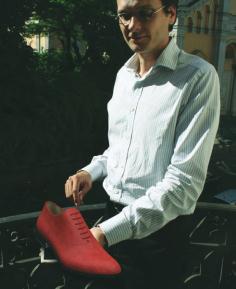
Augmented reality allows a virtual shoe to appear to be
held in a real hand.
CREDIT: SEAC02, TURIN