

33
U
S outdoor footwear brand Merrell launched its first
range of so-called ‘barefoot running shoes’ at this
year’s OutDoor trade show in Friedrichshafen. The
brand is by no means the first to create such minimalist
shoes, but its insistence that the barefoot genre should now
have a place in mainstream footwear, alongside running,
cycling and tennis shoes, poses an interesting idea.
Although the earliest known use of shoes dates back
10,000 years (according to an article published in 1999 by
Connolly and Cannon), barefoot running as we know it today
first entered the public sphere in 1960, when Abebe Bikila
of Ethiopia won the Olympic marathon in Rome barefoot
after deciding that his team-issued shoes hurt his feet.
Throughout the rest of the 20th century, a number of
prominent professional runners threw off their shoes in
favour of running barefoot but, even at the beginning of the
21st century, the style remained on the fringe of a larger
running community.
Proponents of the ‘barefoot movement’ claim that most
athletic shoes, with their strong soles, structured sides and
cushioned inserts, keep feet restricted so they might be
making the wearer’s feet lazy, weak and more prone to
injury. They argue that barefoot running is healthier for feet
and reduces the risk of chronic injuries, including repetitive
stress injuries due to the impact of heel strike in padded
shoes. But even those who run barefoot professionally say
that people trying it out for the first time should start slowly.
The launch of Merrell’s barefoot range suggests that
increasing numbers of people are buying minimalist
‘barefoot’ shoes to ease their way into running barefoot, or
perhaps to test drive the idea of it.
A happy coincidence
It seems that footwear companies did not initially set out
to create shoes which would mimic barefoot running; rather,
consumers chose the closest thing on the market to barefoot
and used it for their own purposes. A quirky foot-glove
called the Vibram FiveFingers was developed by Vibram in
2006, as a way for sailors to have improved grip on their
boats. The shoe was quickly spotted and adopted by
barefoot trainers. Clearly, other footwear brands noticed this
growing consumer trend, and not long after the launch of
the FiveFingers, Nike launched its own product called the
Nike Free, which it claimed mimicked the sensation of
barefoot running. Since their launch, sales of the FiveFingers
have tripled every year and reached 11 million in 2009.
More than a dozen other brands followed suit, and there
are now ‘barefoot’ shoes by Fila, New Balance and adidas,
as well as a number of other companies. Merrell’s new
THE BARE NECESSITIES
Footwear brand Merrell recently teamed
up with a professional barefoot runner to
promote its first range of ‘barefoot’ shoes,
showing that sometimes the old proverb
is true – if you can’t beat them, join them.
The bare necessities
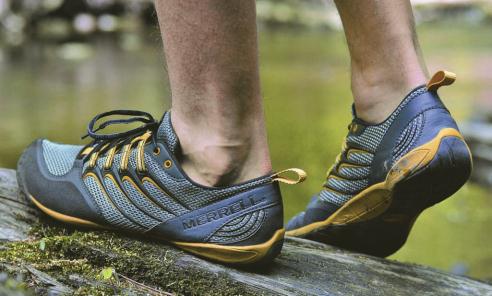
Merrell’s Barefoot Trail Glove
features a lightweight mesh upper
with a fused rubber toe bumper
for protection, as well as 4mm
compression molded EVA midsole
cushions.
CREDIT: MERRELL