
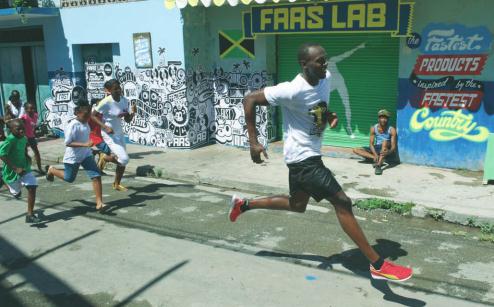
THE SPEED OF LIGHTNESS
I
t’s a law of physics that a larger mass takes more energy to
accelerate than a smaller mass. To translate this into
athletic footwear, the lighter the shoe, the faster you run –
or so the big brands are saying. Take Puma’s new Faas range
of running shoes, for example (featured in the May/June issue
of
World Footwear
). Puma claims to have created “the best
running shoe on the market” by taking a minimalist approach
to the design and developing a lightweight and purely
functional trainer. Faas shoes are numbered according to the
amount of cushioning and structure they have, with 100 being
the lightest and 1000 the heaviest. At 175 grams, the Faas 250
is no heavier than a Frisbee. According to Philipp Hahm, team
head of running for international footwear at Puma, “Without
using or adding any plastic materials to the footwear, we’re
ensuring that the shoe is flexing specifically in those areas
where biomechanically it makes sense and it’s enhancing the
running feeling of this footwear.”
There is not yet a standard weight at which a running shoe
can be classed as ‘lightweight’, but it is generally agreed that
anything less than 283.5 grams in a men’s US size 9 fits the
bill. Lightweight running shoes are on average about 25%
lighter than traditional running shoes. According to industry
research organisation SportsOneSource, lightweight sports
footwear accounted for 28% of the running category in the
US in the second quarter of 2011 (it’s worth noting that
minimalist or barefoot styles, a subset of lightweight,
accounted for 5% in the running category.)
Matt Powell, an analyst with SportsOneSource, said that
the second quarter marked a turning point, as lightweight
products began to “cannibalize” traditional running
categories, such as cushioning and stability. Lightweight
athletic shoes are expected to hit $1.8 billion in sales this
year (compared to $1.1 billion in sales for athletic shoes’
other trend, toning shoes).
Consumer demand
Lightweight shoes are not completely new to the market.
Unlike barefoot or super-minimalist footwear, lightweight
shoes offer some cushioning and support and are therefore a
kind of midway point between heavier, traditional running
shoes and barefoot shoes, such as Vibram’s FiveFingers.
Racing flats have long been used for track and field and
many long distance runners use lightweight shoes for
training purposes. But with advancements in foams and
meshes, running shoes have been getting lighter and lighter
– and it seems that consumers are responding positively.
“You’re seeing a lot of innovation coming in and people
are bringing a lot more to the table in lightweight shoes
overall,” SBU manager at New Balance, Katherine
37
Lightweight sports shoes have rocketed
this year, accounting for nearly a third of
sales in the running category in the US.
The speed of lightness