
SAFETY FIRST
detectors are employed for security reasons. Aluminium caps
are now also more widely used for similar reasons.
Components of this type present challenges in the way
they are assessed since they behave differently in both
standard tests and in wear to items made from steel. For
example, steel caps will usually permanently deform on
impact whereas a plastic cap might spring back to shape but
suffer cracking, giving the impression that it is undamaged.
It could however fail badly should it suffer a second similar
impact which the wearer might well not expect to happen. It
has therefore proved necessary to create new tests that take
these factors into consideration.
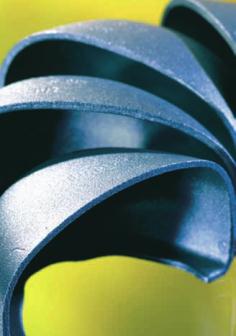
Steel caps
- the classic hardened steel toe cap does
however remain the most widely used and manufacturing
methods have changed little over the years. A cap is
blanked, formed and flanged from annealed carbon steel
using deep drawing presses. It is then furnace hardened to
various standard specifications followed by painting to
prevent corrosion. Production is generally fully automated
and the investment in tooling required to produce the
diversity of shapes now required to meet all the varying
performance standards is obviously considerable.
Working to fine tolerances is also important and
technology now exists where special steels which accept
hardening without deformation are used to produce caps
with dimensional tolerances of less than 0.6mm. This results
in caps that are ideal for injection moulded footwear as their
precise 90
flange angle avoids production problems often
encountered with traditionally made caps.
Aluminium
– aluminium caps have all the strengths and
properties of a steel cap but with weight savings of anything
up to 50%. The main reason behind the demand for
aluminium, however, is that it is non-magnetic and, as
previously remarked, does not interfere with security
scanning at airports and similar locations. Foot comfort is
also said to be enhanced because there is less of a cold feel
within the boot or shoe. An aluminium cap is more
expensive and, if it is thicker than the conventional steel cap,
can cause problems in footwear manufacture.
Composites
– these use a special non-metallic composite
material which is up to 40% lighter than steel, non-magnetic,
non-corrosive, non-conductive and retains heat 50% longer.
They usually have similar if not the same dimensions as a
steel cap which means no sole mould modifications are
needed although some alteration to lasts may be found
necessary. They also recover shape after any impact and
provide space to withdraw the foot more easily.
Synthetics
– various materials have been tried and, of
these, the most effective so far have been thermo-setting
glass fibre, polycarbonate and Kevlar. Each has its own
advantages and drawbacks, not the least of which is cost.
PENETRATION RESISTANT INSERTS
While more industrial foot injuries are caused by
crushing from above, there is also the risk of penetration
from below and, although the soles of industrial boots are
generally extremely tough and substantial, they do not
always provide sufficient protection.
The traditional solution has been to place a shaped thin
steel plate between the sole and the insole. This offers
excellent protection but, for obvious reasons, is necessarily
limited to the area within the inner edge of the lasted upper.
It also adds yet more weight as well as reducing flexibility. It
was also found to be less easy to apply to the increasingly
widespread use of the sewn-in sock method of construction
referred to earlier.
The answer appeared in a clever composite material
produced by combining para-aramidic fibres (Kevlar) with
appropriate coatings. Originally conceived for use as
protective panels in body armour and chain-saw protection
pads for footwear and clothing, it was but a short step to
underfoot protection.
A special ceramic coating is used to compact and
reinforce layers of hi-tenacity high density weave polyamide
fabric (SS) and Kevlar fabric (BS). The result is a flexible
board which can be used as a non-metallic insert in safety
footwear. As well as performing to the required standards, it
is relatively lightweight, flexible, has no thermal conductivity
and is non-reactive with metal detectors. It can also be cut to
shape using single layer die-cut shearing and is eminently
suitable for use with sewn-in sock where it can be made to
follow just inside the feather edge of the lasted upper and so
provide the maximum extent of protection possible.
The increasing use of lighter weight and more
fashionably styled safety footwear for men and, more
19
Steel safety toe caps.
CREDIT: ESJOT GOLDBERG