WORLD FOOTWEAR
SEPTEMBER/OCTOBER 2011
particularly, women in the workplace has been a further spur
to the development of both caps and inserts made from non-
metallic materials.
SLIP RESISTANCE
Soles and soling materials for safety footwear must be
tested for non-cleated thickness, tear strength and resistance
to abrasion, flexing, hydrolysis, chemicals and slip. The latter
is, in fact, the major cause of all industrial accidents involving
footwear. It has received special attention in recent years
although it has proved difficult to reach a consensus on the
best test method to use.
A provisional method was proposed as ENV 13287:2002
(ENVs are experimental methods for consideration by CEN
countries but without the weight of a full EN) and then
refined to become the current EN 13287 standard in
operation today as part of the overall European EN ISO 20344
series. The procedure used is similar in many ways to the
established SATRA TM144 test for slip resistance.
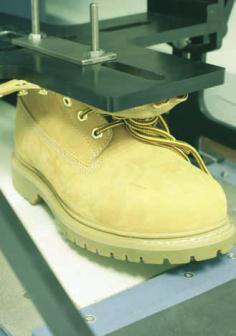
The method calls for two flooring surfaces (steel and a
pressed ceramic tile), two contaminants (glycerol and water
containing the wetting agent sodium lauryl sulphate or NaLS)
and three slip modes. Other surfaces can of course be used
outside the official method (ice being a good example) and
test conditions varied according to the size of the footwear (a
higher downwards force being used on bigger sizes).
Needless to say, because safety footwear has to comply
with such strict performance standards, it must necessarily
be subjected to an immense amount of testing of materials,
components and the finished product. This can be an
expensive process, so it is as well to have an appreciation of
just what can be expected of all the materials and
components involved.
UPPER LEATHERS
Increasingly tough safety standards have also made the
selection and testing of upper leathers a vital consideration
for safety footwear producers. An important factor to bear in
mind is that differences can exist between the properties of a
leather when it leaves the tannery and when it is taken from
completed footwear where it has become part of a three-
dimensional construction, possibly involving several
materials. In this instance, leather properties may be
influenced by conditions imposed during construction by the
other materials involved or the design itself.
While upper, tongue and lining leathers have different
requirements, they share essentially the same test methods.
These are tensile strength, tear strength, breathability, water
vapour permeability (WVP), water vapour absorption (WVA),
water vapour coefficient (WVC) and pH value to determine
acidity (too low and it can cause skin irritation).
Testing for water resistance is optional for safety
footwear but mandatory for specialist applications. A
further option for water resistant footwear is the trough test
which determines the degree of water penetration after
walking 1,000 paces in a trough with the top of the shoes’
soles 5mm below the surface of the water and upper seams
20
Assessing slip resistance on a ceramic tile.
CREDIT: SATRA
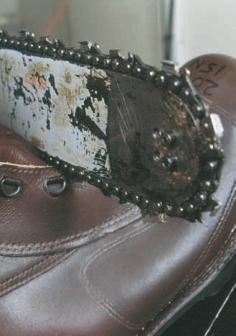
Testing resistance to chainsaws.
CREDIT: SATRA