
A NEW SUSTAINABLE FIBRE
the most advanced innovation in carpet fibre technology in
the last 20 years. It went on to claim that features including
softness, stain protection, durability and environmental
benefits all added up to better consumer satisfaction.
CARPETS TO LININGS
Although carpets had little in common with shoe linings,
Ms Stangl began to wonder if this new fibre could make the
transition from ‘underfoot’ to ‘against’ the foot. To find out,
she began discussions with the DuPont team at the Winter
Outdoor Retailer show in early 2010 and, within a very brief
period of time, she had her answer.
“On every count we use to measure performance
characteristics of a fibre, Sorona was superior. Its hand was
just as Mohawk had described it, very soft with an amazing
feel against the foot. It was durable and had outstanding
elasticity that resisted stretching and sagging. And, most
importantly, it was made from fermented plant sugars and
thus was sustainable. As an added bonus, the Sorona
manufacturing process produced about 63% fewer
greenhouse gases and used 30% less energy than nylon
manufacture. This fibre gave us another new arrow in our
quiver of recycled and renewable fabrics as well as a unique
marketing story to tell.
“The new product also fitted in well with our long-term
goals. We have been very fortunate to have been able to build
a successful business around our Dri-Lex range, the original
line of synthetic moisture movement fabrics which my father
first introduced in the 1980s. When you have a successful
company, you can start thinking a little further into the future
and do some things that you might not otherwise be able to.
“We decided many years ago that it was important for the
company to produce as many environmentally friendly
fabrics as our customers could use while also looking to the
future and putting considerable resources into the
development of new fibres and constructions. In this
instance, DuPont delivered an extraordinary new fibre which
fitted perfectly into that vision.”
Shortly after the initial discussions at Outdoor Retailer,
Faytex and its Chinese partner Tai Lee Textiles developed
seven new prototype fabrics containing up to 100% Sorona
yarns. Each construction differed substantially from the others
with one, for example, offering maximum abrasion resistance
and, another, a sueded look and hand feel. Some fabrics in the
collection offered dimensional interest through waffle designs
or two-tone looks. They all also either duplicated or closely
resembled existing Dri-Lex constructions.
As Ms Stangl observes, “We tried to anticipate our
customers’ various needs with these new Sorona-based
products, so the variety of looks is intentional. We were
also pleasantly surprised at the brilliant colours we were
able to produce.”
Because so many exsisting and potential Dri-Lex
customers exhibit at the Outdoor Retailer show in Salt Lake
City, Ms Stangl decided the best opportunity to test the
viability of the new fabrics quickly was to have a larger
presence at that show. Her strategy was to be in the same hall
as DuPont so they could play off of each other and tell the
Sorona story more effectively. Did it work? “Although the
interest was there and we had some good conversations, as
with any show, follow-up was crucial,” she comments.
UNEXPECTED RESISTANCE
Ms Stangl was surprised however to discover that, when
they first started their sales calls following the show–as well
as at subsequent trade shows–Sorona’s origins as a
monomer made from fermented corn sugar was troubling to
a number of executives at the companies being called on.
Frankly, it was discouraging and, unfortunately, these were
the people charged with bringing new sustainable fabrics
into their respective companies. One company in particular,
which was publicly on a mission to make its products as
‘green’ as possible, rejected out of hand the concept of
making fibres and fabrics from foodstuff.
To introduce Sorona, DuPont had initiated an aggressive
marketing campaign that prominently featured corn as the
source of its fibres. Even though the corn was ‘dent’ corn
used primarily to feed livestock and, once the sugar was
removed, it went back to its original purpose, the image of
taking food from the ‘mouths of babes’ was difficult to
overcome. In one instance, a year later, after countless
discussions, Ms Stangl says that it has become apparent that
they cannot overcome this erroneous thought process at that
particular company.
Companies that heard the story and were initially hesitant
to adopt Sorona-based fabrics proved, however, to be in the
minority. Over the past year, more than a dozen footwear
23
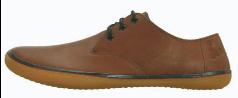
This style called Ra by Terra Plana combines a leather upper
with a Sorona-based lining.
CREDIT: TERRA PLANA
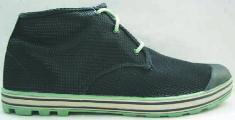
The upper of this ankle boot by Palladium is made entirely
from Sorona-based fabrics.
CREDIT: PALLADIUM