MANUFACTURING & MATERIALS INNOVATION
WF
26
I
n the March/April issue of
World Footwear
, an article on
Prize Boots looked at the high degree of skill
possessed by English hand shoemakers
in the first half of the 19th century. The
second half of that century witnessed
the invention of machines that turned a
handcraft industry into a highly mechanised one
which employed large numbers of people in towns spread
across the country. Amongst these, Northampton in
particular gained a reputation as the producer of the very
best men’s boots and shoes that has lasted to this day.
What were the factories like that led this expansion of the
footwear industry from the late 1800s up to World War I?
Very few of the original companies survive and, of those,
hardly any have a complete photographic record of the time.
One exception is Crockett & Jones, established in
Northampton in 1879, still owned by the same family and
still making shoes to the same high quality as when the
company first started.
BACKGROUND
In the Middle Ages, Northampton’s location at the junction
of the principal routes from north to south and east to west
made it the ideal place to receive hides from butchers spread
over a wide area. It was also surrounded by oak forests from
which timber was taken for housing and ship building. Oak
bark was the best available tanning agent at the time, so the
town became the most important centre for tanning leather
in the country. And, with leather readily available,
shoemakers soon followed.
As has already been remarked, up until the middle of the
19th century, shoemaking remained essentially a craft
industry. The invention of the lockstitch sewing machine
in 1846 followed by that of the Goodyear machine welting
process in 1871 changed everything as it now became
possible to mass produce uniform footwear in purpose
built factories.
STARTING UP
The problem for a would-be shoe manufacturer in the late
1800s was the same as for any potential entrepreneur
today: raising the capital to get started. Charles Jones and
his brother-in-law James Crockett were fortunate that in
1879 they each received £100 from a charitable trust
founded ‘to encourage young men of good character in the
towns of Northampton and Coventry to set up in business
on their own’.
In common with almost all their competitors they were
able to start in a small way as much of the shoemaking
process was still carried out by handworkers at home, with
only the cutting of components and final finishing taking
place in the factory, before the completed shoes were sold to
retailers. As the century neared its end, so an ever increasing
variety of machines became available necessitating large
factories employing substantial numbers of people.
These photographic images show the five story extension
made to the original Crockett & Jones factory in 1911 and
A STEP
BACK IN
TIME
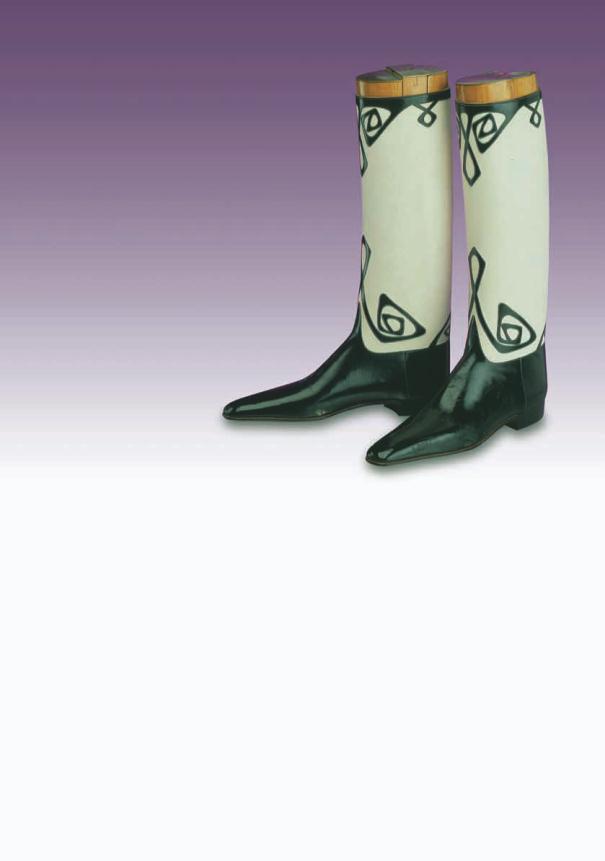
Crockett & Jones dress boot from the early 1900s.
CREDIT: NORTHAMPTON MUSEUMS AND ART GALLERY