
A STEP BACK IN TIME
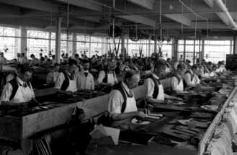
Lasting:
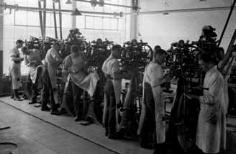
After pulling-over, lasting for welted shoes would be
performed on a hand operated flatbed machine using wiper
plates and, for flat lasted constructions, a pincer machine
which pulled and twisted the upper to form pleats as in hand
lasting. The photo shows a row of the latter. They were hard
work and operators soon gained upper body strength and a
real ‘shoemakers grip’.
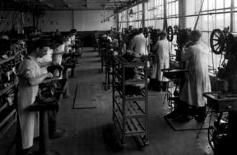
Welting:
The welt sewers working on the right were key
employees as the seam between welt and insole rib is the
foundation of a welted shoe. While both they and the inseam
trimmers further down the room are positioned to receive good
light, the operators performing ancillary tasks had to make do
with less. Work in progress was carried on wooden racks which
were moved from floor to floor by a simple hand operated lift.
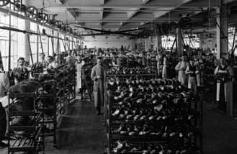
Making:
Key operations such as rough rounding and outsole
stitching (left) were located down each side against the
windows with the centre of the room containing operations
such as sole attaching, channel closing (front right), sole
levelling and heel attaching. It was invariably crowded with
racks waiting at each of a large number of separate
operations. This in turn meant far more lasts were used than
today but, at the same time, that shoes stayed on the last
longer and this helped them to retain their shape.
Finishing:
This either formed a special section of the making
department or was located on the ground floor so that racks
of finished shoes could be wheeled straight into the shoe
room and packing department. The finishers trimmed,
scoured, waxed and edge set the soles and heels using a
variety of machines all running at different speeds. Main line
shafting only ran at a constant speed so the size of the shaft
pulley for each machine had to be matched to the one on the
later such that it ran at the correct speed.
Clicking:
Shoe factories at the end of the 19th century were
built in the middle of towns. Land was at a premium so they
were built several stories high. Clicking departments were
traditionally on the top floor where the light was best, with
closing on the next floor down, followed by lasting, welting,
and making as more machines became involved and the
weight on each floor level increased.
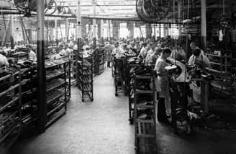
Closing:
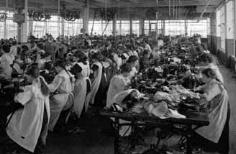
Sewing machines were driven by leather belts off a
central shaft under the bench which was itself driven by
either overhead shafting as in this instance or by an electric
motor underneath. Note the absence of any guards on drive
belts; health and safety was not a major consideration 100
years ago despite the long flowing dresses all women wore at
the time.
27