WORLD FOOTWEAR
SEPTEMBER/OCTOBER 2011
were taken shortly after production began. It shows an open
and airy factory due to its then revolutionary steel framed
construction. As the first such structure in the town, it now
carries a preservation order even though it is still very
much in use. Although the working conditions shown were
better than many factories at that time, the images
nevertheless bring home to us the large number of people
and different machines needed to produce a top quality
shoe 100 years ago.
THE COMPANY TODAY
The most remarkable thing is that not only has the
company survived the decimation of the UK footwear
industry that has seen Northampton’s 100 plus shoe
factories in 1960 fall to just a handful today but that the fifth
generation of the family is now involved. Furthermore,
although production at 3,000 pairs per week bears no
comparison with the 15,000 pairs per week achieved in
1920, it has nevertheless been steadily increasing over the
past few years, a sound testament to the family’s refusal to
compromise their high standards.
While modern machinery is used wherever appropriate,
the attention to traditional detail which is a mark of the
company’s products means that a significant number of old
machines remain in use maintained by spares taken from a
store of old ones acquired whenever there was a factory
closure. Were the employees seen here in 1911 able to step
forward 100 years, they would still recognise the factory and
many of the procedures that are still employed to complete
a pair of Crockett & Jones shoes.
28
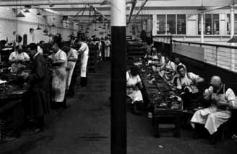
Shoe Room:
In most modern factories, this would now be called
the finishing department as completed shoes were cleaned,
polished and inspected for quality. Most of this would have
been carried out by hand much as it is today. Women in shoe
factories were only employed as closers, in the shoe room and
in the offices. Regardless of the department involved,
supervisors were always men.
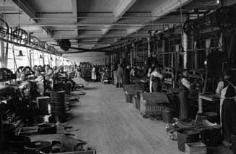
Roughstuff:
As upper leather went in at the top of the
building, soling leather went in at the bottom. Most factories
cut and processed all bottom stock components themselves. As
many of the machines were extremely heavy, the department
was often located in a semi-basement area. The ‘Revolution’
cutting presses shown had a constantly turning flywheel which
was tripped by a foot treadle to bring the beam down on to
the forged steel cutting die which the operator held with both
hands. While fast, they were also dangerous and operators
often lost one or more fingers.
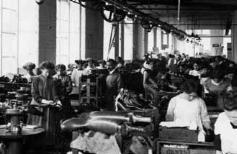
Handsewn:
The very best welted shoes might have had both
the welt and sole seams sewn by hand as the flatter insole rib
produced a more flexible shoe than the machine welted
version. Hand sewers needed no machines, just somewhere to
sit and a tray to hold their tools as they held the lasted shoe
down to their legs with a simple strap tensioned by one of their
feet in the same manner as the old hand shoemakers (centre
foreground). They could therefore be fitted in wherever there
was a convenient area which, as can be seen here, was not
necessarily the best that the factory had to offer.
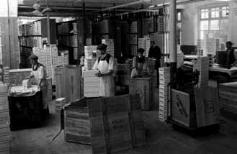
Packing:
This view has been specially ‘staged’ to demonstrate
the extent of the company’s export trade, with Milan,
Brussels, Buenos Ayres and Melbourne all visible on packing
cases. The company was in fact awarded the Diploma of
Honour at the 1911 International Manufacturing Exhibition in
Turin. Note the staff all wearing caps.
CREDIT: ALL FACTORY IMAGES CROCKETT & JONES